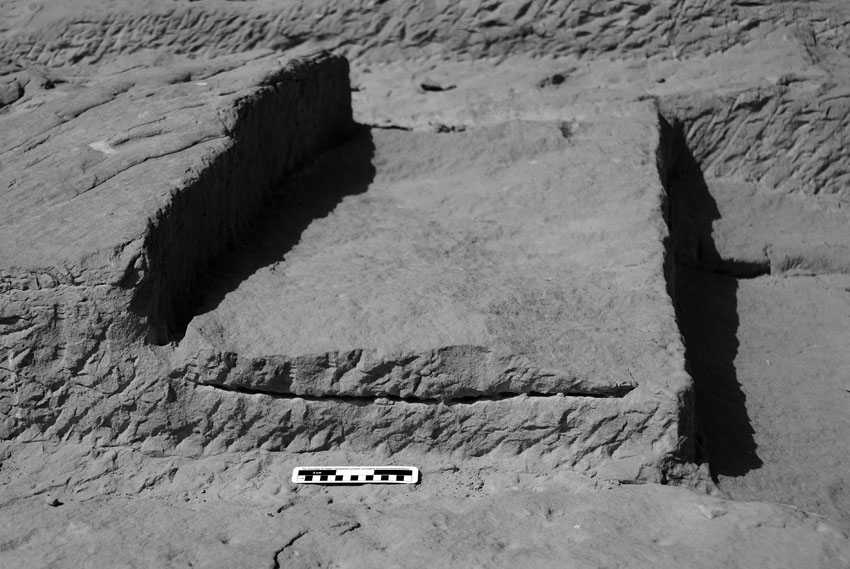
Chisel holes left in a failed attempted to induce a fracture along the base of a block in the Middle Kingdom Wadi Shatt el-Rigal sandstone quarry near Gebel el-Silsila. Note the rough upper surface where the block broke free of the bedrock above the line of chisel holes. Smallest scale division is 1 cm. Photo by JAMES HARRELL.
Chisel holes left in a failed attempted to induce a fracture along the base of a block in the Middle Kingdom Wadi Shatt el-Rigal sandstone quarry near Gebel el-Silsila. Note the rough upper surface where the block broke free of the bedrock above the line of chisel holes. Smallest scale division is 1 cm. Photo by JAMES HARRELL.
Discover more from Per Storemyr Geoarchaeology & Conservation
Subscribe to get the latest posts sent to your email.
 Per Storemyr Geoarchaeology & Conservation
