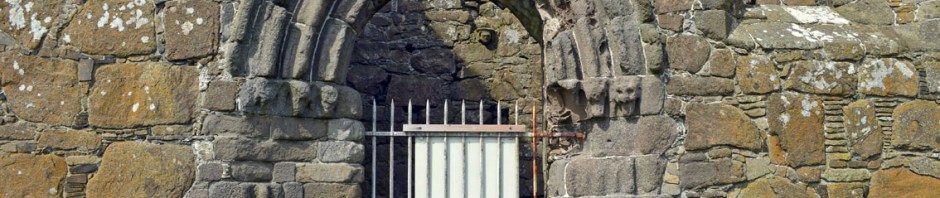
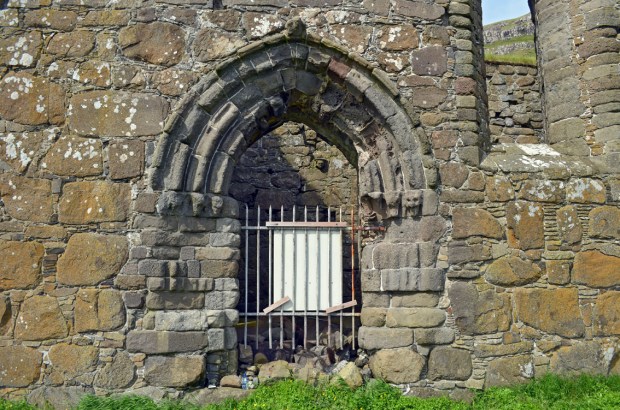
The medieval cathedral of the Faroe Islands is a half-ruin. Here’s the south portal in the nave, carved from soft basalt and within a rubble masonry of hard basalt fitted tightly together with basalt pinning stone and minimal use of seashell lime mortar. Photo by Per Storemyr
Presented in Tórshavn earlier this year, “The Cathedral of Kirkjubøur” is a book covering all you ever wanted to know about building a big Gothic church in the middle of the North Atlantic – 700 years ago, and far away from contemporary European centres of stone architecture. Edited by Kirstin S. Eliasen and Morten Stige, the book contains 18 papers with various perspectives on the archaeology and building history of the church. My contribution is written together with Faroese geologist Uni Árting: How were stone and lime procured on a remote archipelago that basically consists of basalt? Read on and download PDF of our paper.
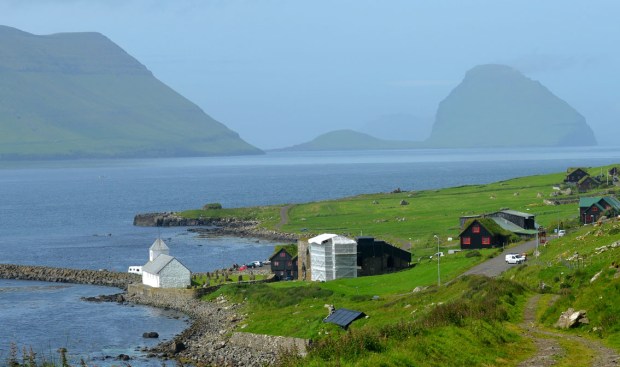
The scenic location of Kirkjubøur, with the cathedral under restoration in 2017. Photo by Per Storemyr
Hard basalt, soft basalt and soapstone
In our paper we introduce the volcanic geology of the Faroes and show how local basalt at Kirkjubøur was procured for building the cathedral’s sturdy and beautiful rubble masonry. But the local basalt was too hard for delicate carving and softer basalts needed to be found farther away to make decorative elements. We have found outcrops 12-17 km by boat from Kirkjubøur that might have provided such stone.
There are only a few foreign stone elements at the cathedral – all made from soapstone used for decorative purposes. But where did it come from on an archipelago without such stone? It is easy to point to Norway with its great soapstone traditions and because the Faroes were part of the Norwegian Archbishopric in the Middle Ages. But the problem is that it is hard to find visually matching soapstone types in Norway. So, did the soapstone rather come from Shetland, which also have long soapstone traditions?
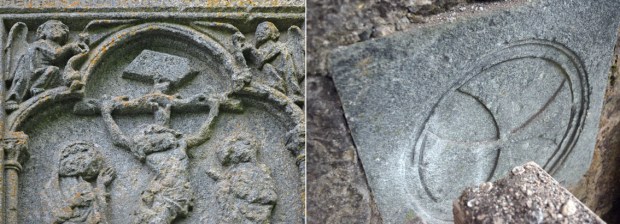
Homogeneous soapstone at the cathedral. Reliquary box and consecration cross. Photo by Per Storemyr
Lime mortars from burning seashell
Moreover, there is no limestone for making lime mortar in the archipelago: But that was a lesser problem, and we discuss how quicklime was manufactured from burning the only resource available: seashell. It is perhaps unlikely that burning took place by the cathedral since, historically, Kirkjubøur is not known for significant shell deposits. But such deposits exist, in fact, close to possible places for soft basalt procurement and one of them was used for lime burning until the early 20th century.
The practice of burning seashells for lime is particularly fascinating because this tradition hardly originates in Norway, where burning marble and limestone dominated in the Middle Ages. Influences rather must be sought elsewhere, not least on the islands off the coast of Scotland, which are well known for this practice.
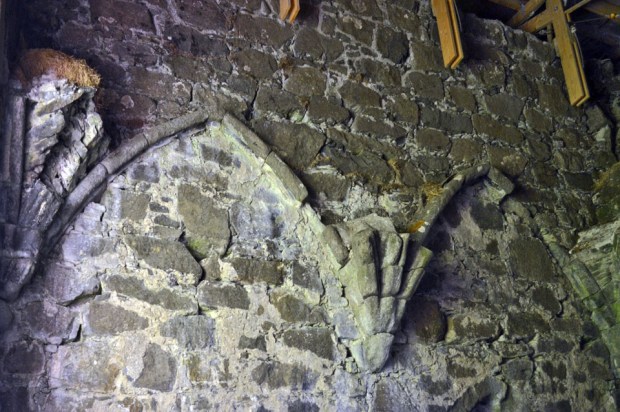
Seashell lime mortars can be most easily seen in the sacristy by the north side of the cathedral. Photo by Per Storemyr
Hypothesis
Thus, with soapstone and lime indicators not easily pointing to Norway, we hypothesize that influences related to material procurement and craftsmanship – and craftsmen – may well have come from the British Isles/Scotland. This is in line with architectural and stylistic traits of the cathedral, discussed by other authors in the new book.
As for now, we can at least conclude that the Faroese Cathedral is a classical example of how local, rough building stones were supplemented with targeted procurement of more distant stones suitable for delicate carving.
*
Please find out more in our paper. It is available as PDF here on this website as wells as on my academia.edu page and includes a list of all the other papers in the book. Here’s the reference:
- Storemyr, P. & Árting, U. (2024): The Stones and Mortars of the Faroese Medieval Cathedral. In Eliasen, K.S. & Stige, M. (eds.) The Cathedral of Kirkjubøur and the Medieval Bishop’s See of the Faroes. Tórshavn: Tjóðsavnið, pp. 301-328
The book, either in English or Faroese, can be purchased from the Faroe Islands National Museum.
Discover more from Per Storemyr Geoarchaeology & Conservation
Subscribe to get the latest posts sent to your email.







 Per Storemyr Geoarchaeology & Conservation
Hi Per,
F.Y.I.: I made a mention of your publication:
https://www.stone-ideas.com/108754/exhibition-idea-forma-chianti-sculpture-park/.
Thank you so much for keeping me informed.
All the best
Peter
Pingback: Exhibition “Idea Forma” at the Chianti Sculpture Park, Pievasciata
09/08/24 Per, Many thanks for your recent efforts at solving puzzles, and sleuthing other very elusive information in the work on the cathedral construction at Faroe Island and the genesis and distribution of Tafoni..absolutely stunning research. I am still chasing the threads of our «Prehistoric Mining with Fire» research, pushing it into far reaching areas along the North American, Atlantic bight and the Gulf Coast, in the use of lower Tertiary rocks, mostly orthoquartzites and cryptocrystalline varieties that were quarried for flaked toolstones. Jack
Very interesting research, Per, especially the combination of the origin of building stone with type of mortar. Also new information for me: soapstone from the Shetlands (we think here automatically to Norway for an origin if we find it in archaeological contexts).
(In the Netherlands the use of seashells for lime mortar was also very common)
Marian Melkert
mariamelkert@gmail.com
P.s We met long ago in Egypt, looking at quarries with Karen van Opstal. I allways read your (English) posts with great interest.
Nice to hear from you Marian, and glad that someone actually reads some of my posts! It was a fine trip in Egypt way back when!Yes, though we are not at all certain that the soapstone at the Faroese cathedral really came from Shetland, it is a good possibility since Shetland had a substantial “soapstone industry”. Interesting with shell mortars in the Netherlands, part of the traditions that stretches along the coasts all the way up to Denmark – and in the North Atlantic. In Norway there was so much marble along the coast that shell was used only very occasionally. Hope you are doing fine and all best! Per
Tusen takk! Så fint. Vi sees I Aalborg Vennlig hilsen Terje