
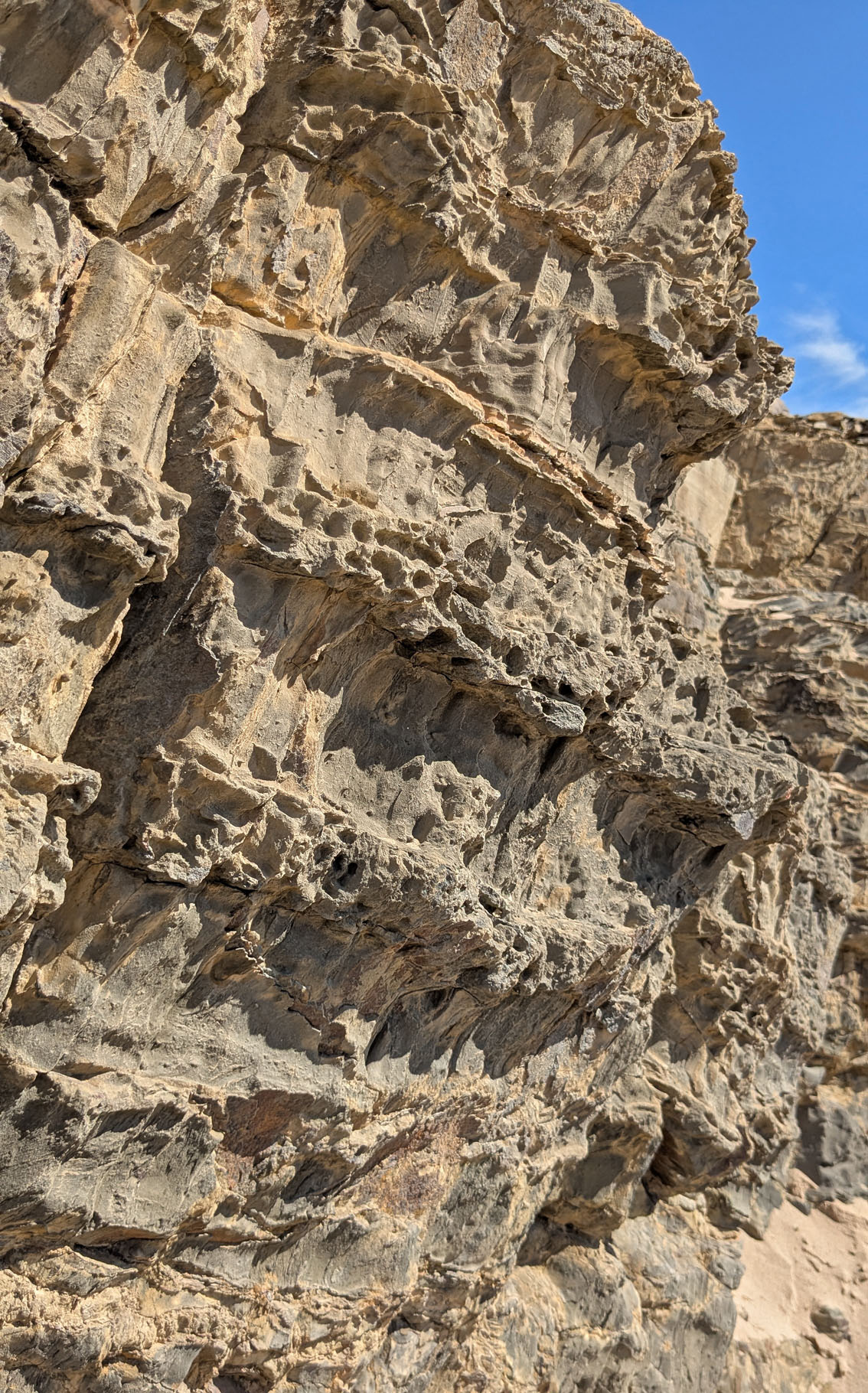
Tafoni weathering in Carbonaceous turbidites at Praia da Amoreira, Costa Vicentina. Photo by PS
This summer’s roadtrip took us all the way from Norway to the southwesternmost tip of Portugal, to Costa Vicentina by the Atlantic. Vicentina offers spectacular coastal cliffs and sandy beaches – perfect places to study geology and tafoni weathering. With cliffs often dominated by Carbonaceous shales and greywackes in turbidite sequences, tafoni weathering is peculiar, visually related to the sturdier layers. Tafoni is also omnipresent in young, Quaternary calcareous sandstones, which is not strange, given that salt and wind along the Atlantic make perfect conditions for tafoni weathering. Here’s a brief report with lots of photos.
Geological setting
With the limestone plateau at Cabo de Sao Vicente the southwesternmost tip of the European mainland, Costa Vicentina and the neighboring western part of the Algarve coast offers an almost complete succession of mainly sedimentary rocks from the Devonian/Carboniferious to the Quaternary – 350 million years (ma) of earth history (see e.g. Ramos & Ramos-Pereira 2020, Oliveira et al. 2009, Reis & Pimentel 2012).
The oldest rocks are extensive, intricately folded and slightly metamorphic turbidites (shale and sandstone/greywacke) related to the Hercynian orogeny (mountain building process), which eventually contributed to the supercontinent Pangea. Later, on Pangea breaking apart, the Algarve sedimentary basin formed with its diversity of limestones, as well as some sandstones and volcanic rocks.
One of the most renowned geological spots is the so-called “Carboniferous – Triassic Unconformity” in Telheiro, where eroded, folded Carboniferous turbidites are overlain by horizontal strata of the Triassic Silves sandstone. It took more than 70 million years of erosion before the Triassic strata were deposited. The red Silves sandstone is an important building stone, used e.g. in the medieval castle and cathedral of Silves.
The youngest rocks, often capping the coastal cliffs, are a variety of sandstones and calcarenites (carbonate-rich and shelly sandstone) of the Tertiary and Quaternary periods, often forming raised beaches and infills in karst terrains, such as connected to the weathered and eroded cliffs of the Algarve coast by Lagos, famous for their dramatic beauty.
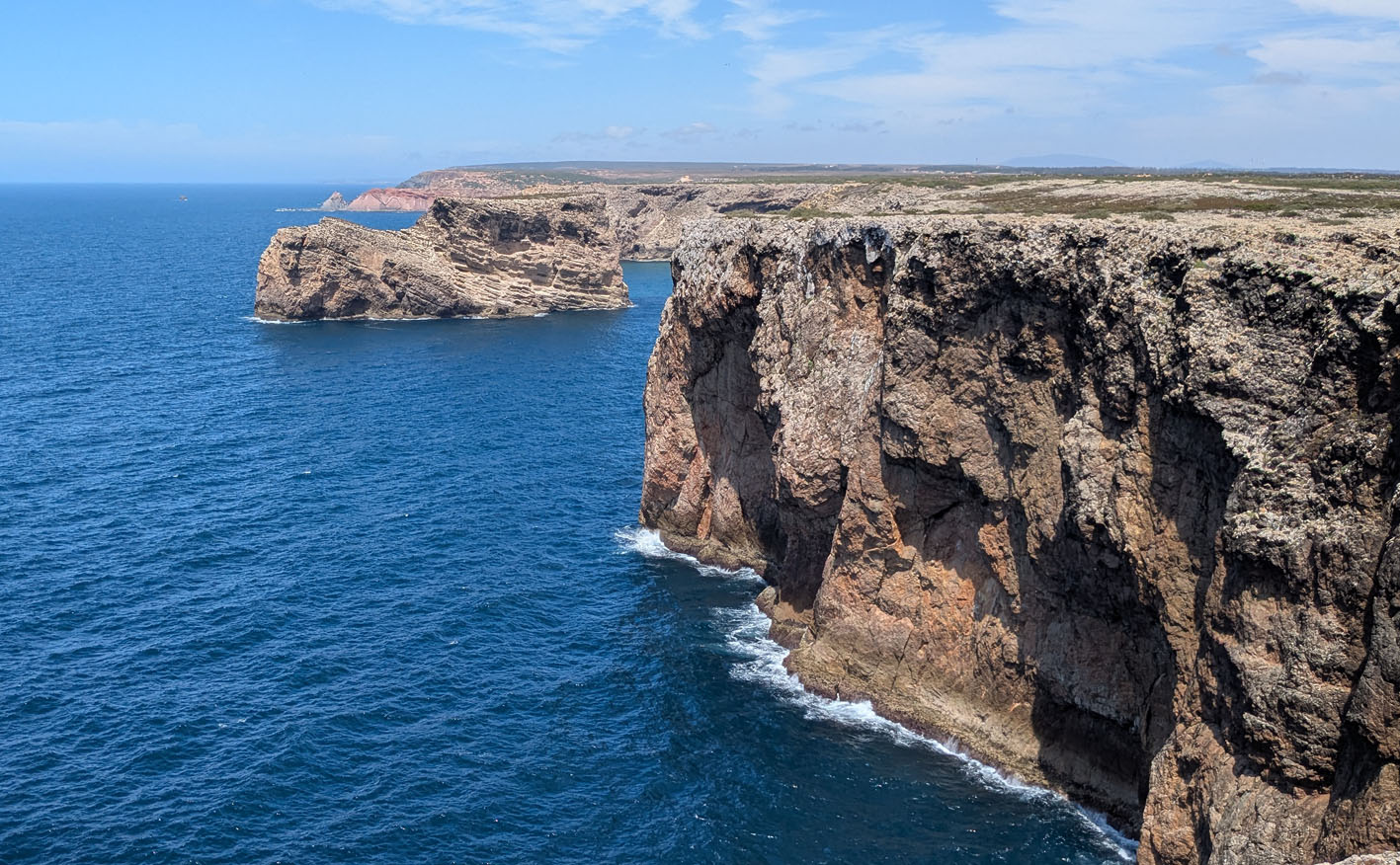
Costa Vicentina as seen from the southwesternmost tip at Cabo de Sao Vicente. Photo by PS
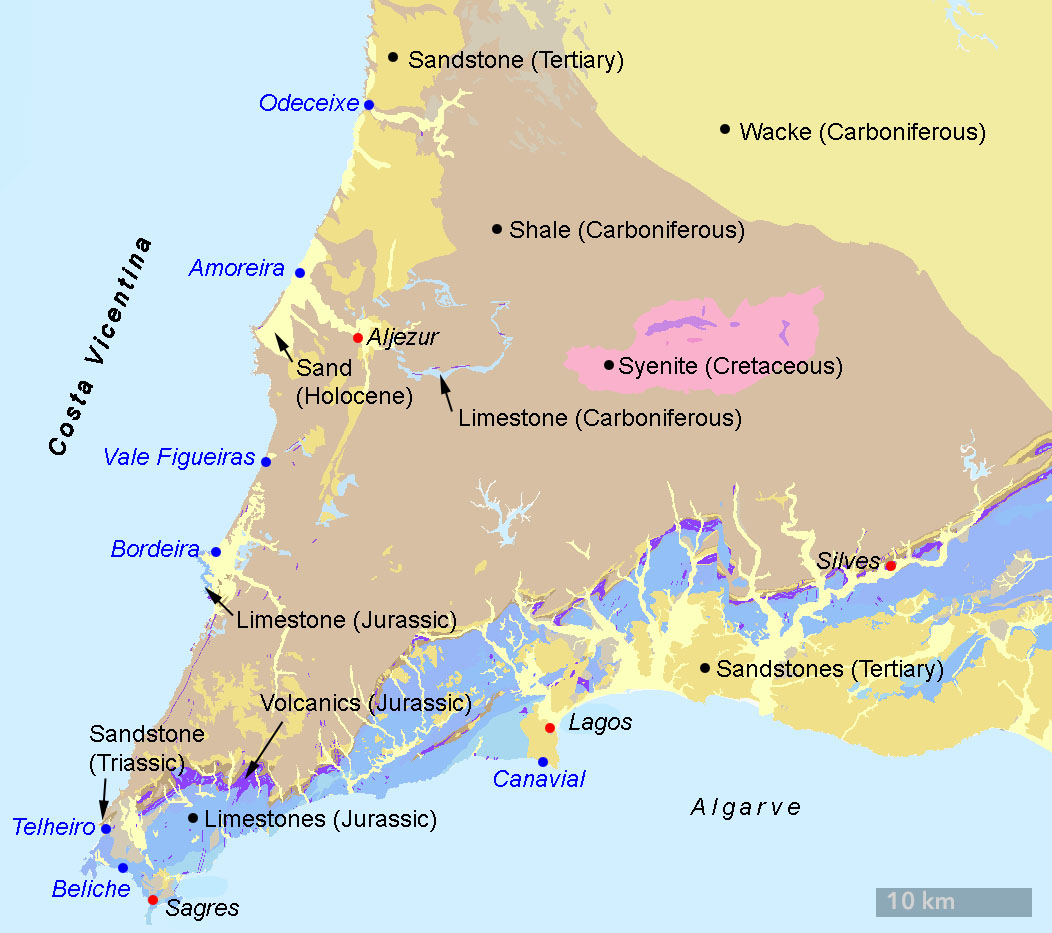
Geological map of Costa Vicentina and the SW Algarve coast. Places mentioned in the text with blue and red dots. Adapted from the Geoportal of Energy and Geology Portugal
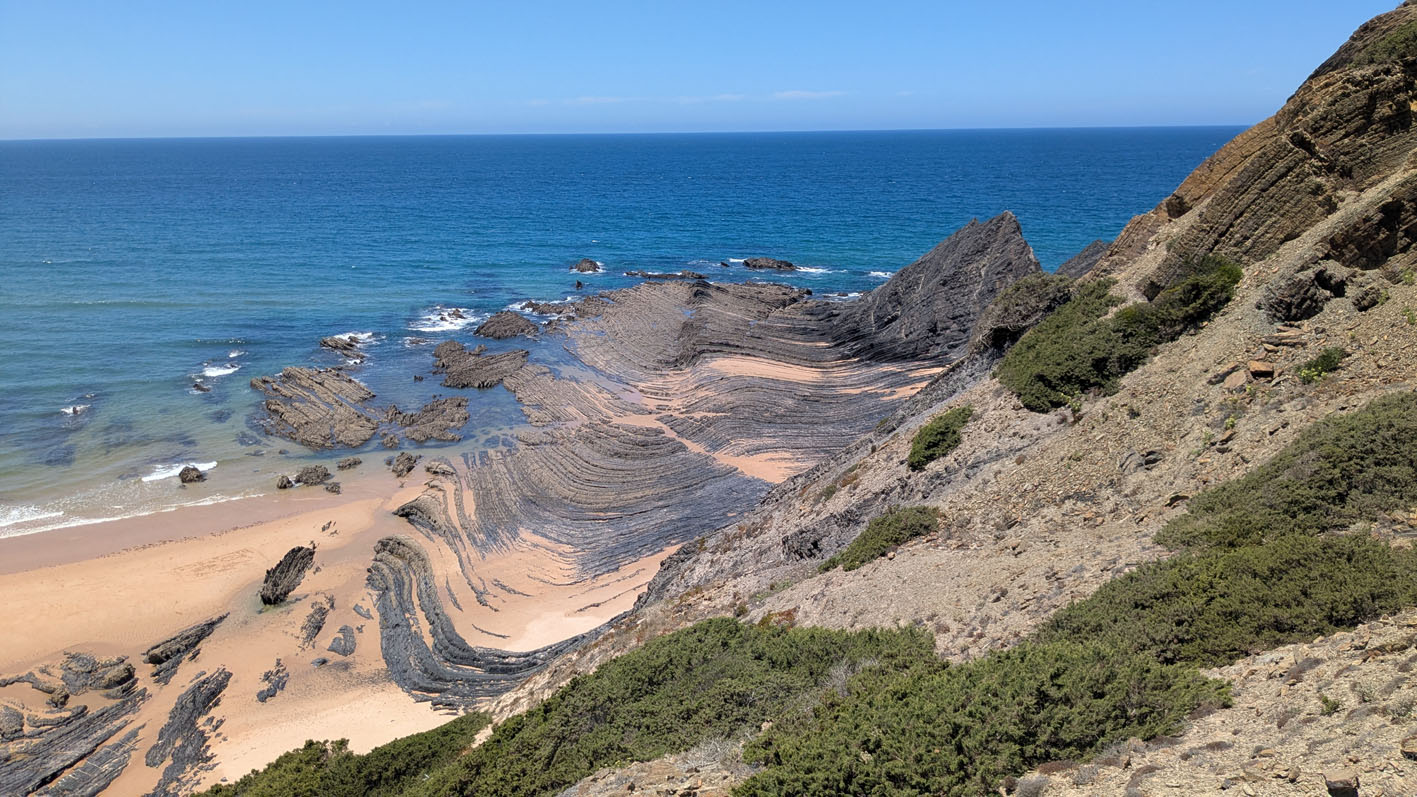
Folded turbidites on the Amoreira beach. Photo by PS

Folded turbidites on the Amoreira beach, cf. photo above. Photo by PS
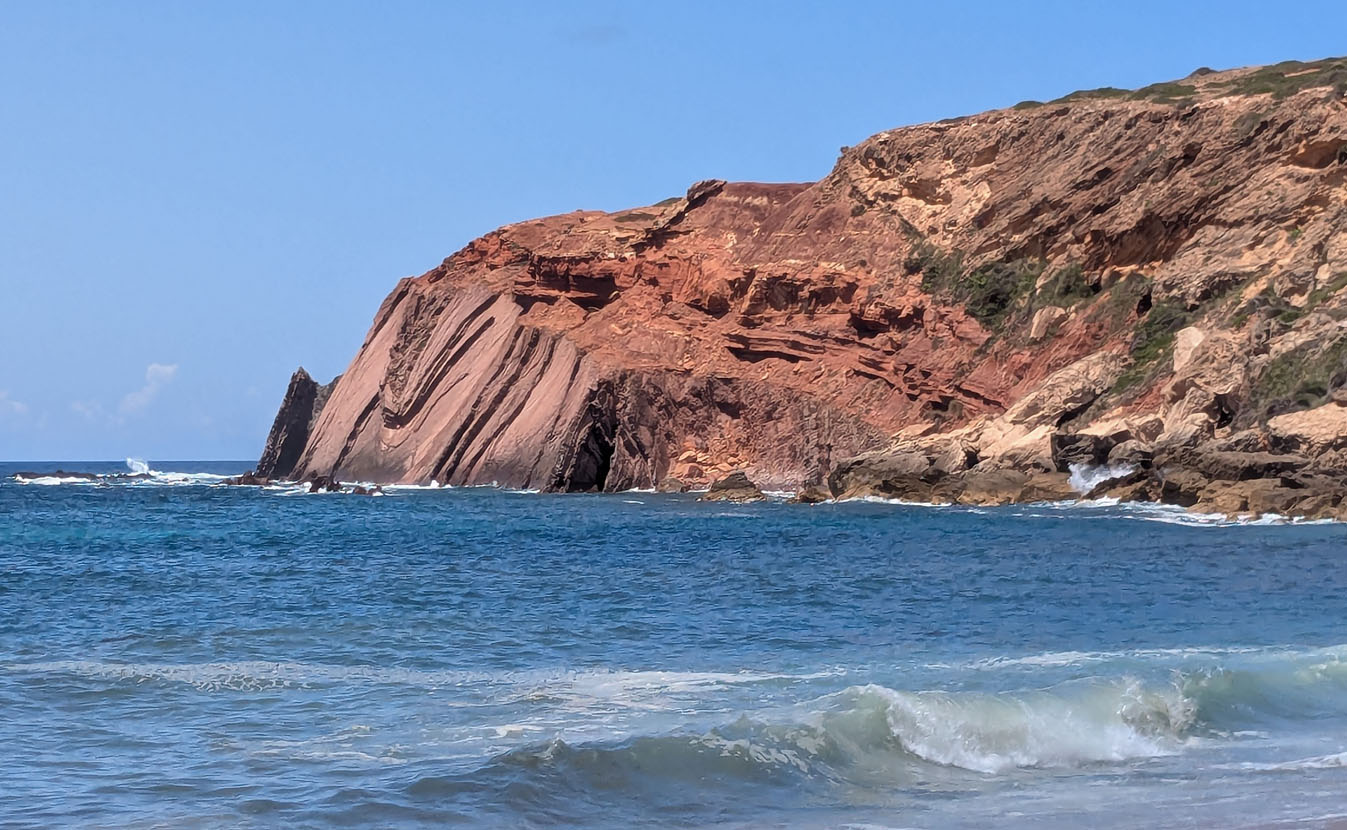
The Telheiro uncomformity, with Carboniferous, folded turbidites below and Triassic (semi)horizontal sandstone beds above (Silves sandstone). Photo by PS
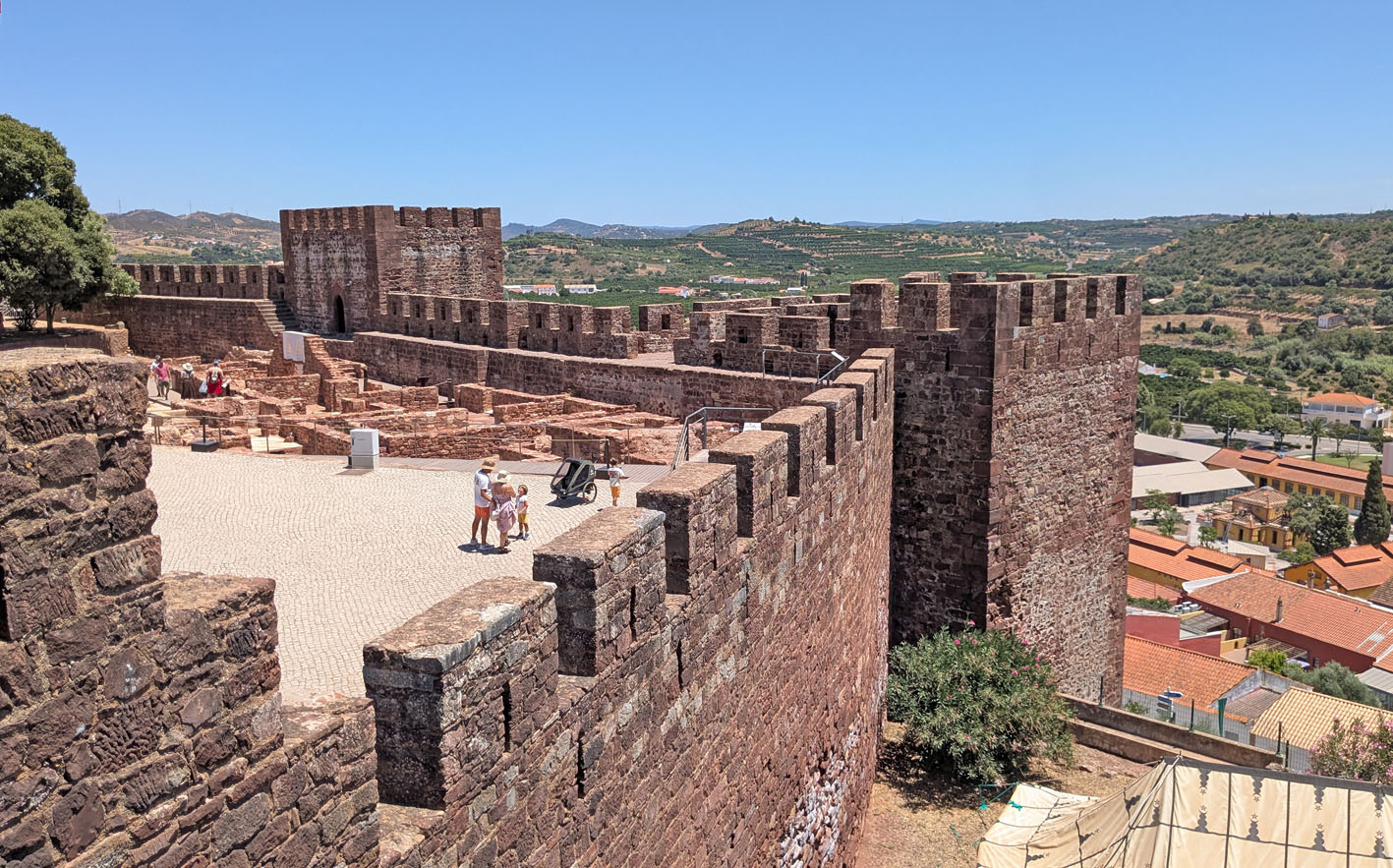
The medieval castle in Silves is built from Triassic red sandstone. Photo by PS
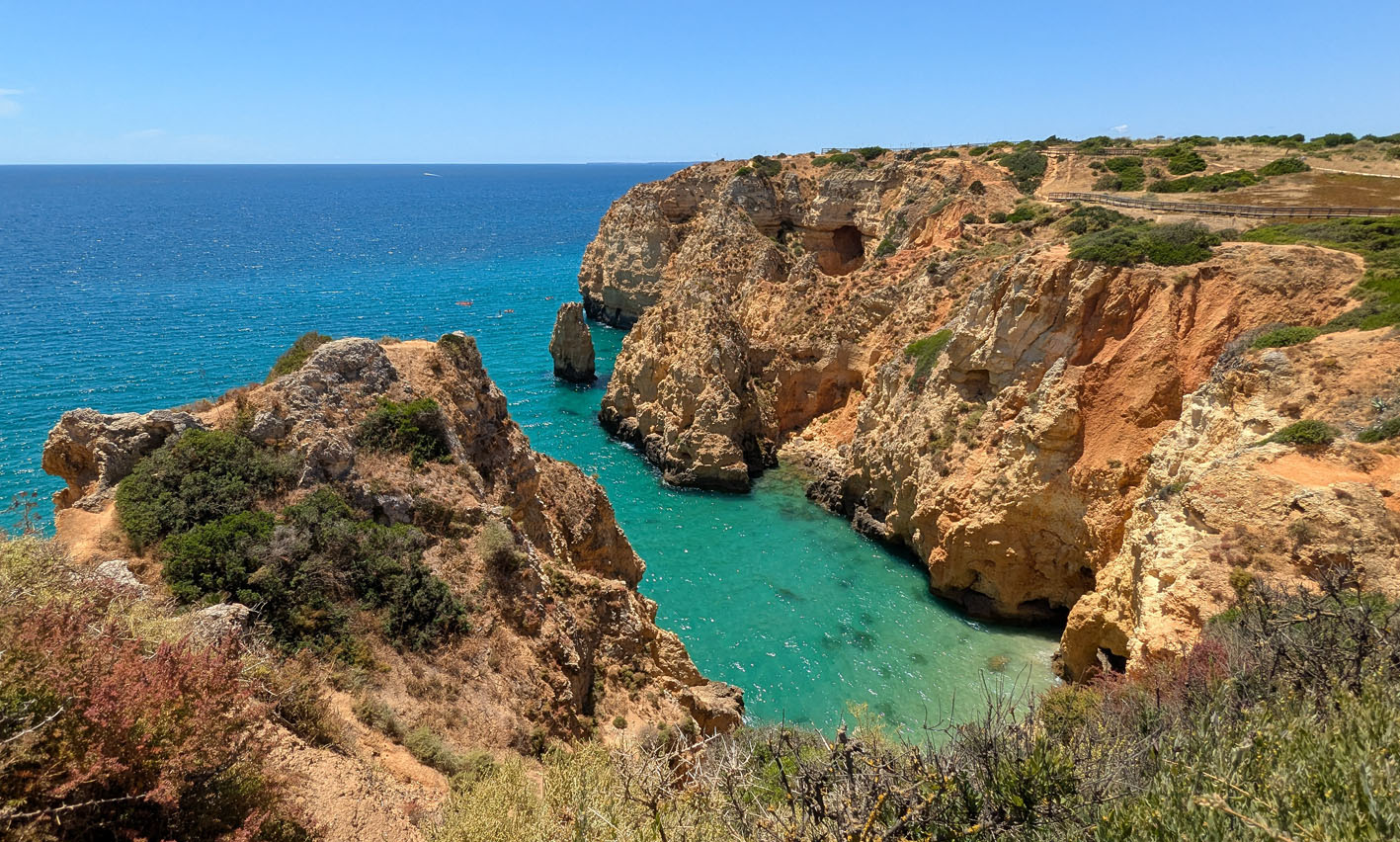
Eroded karst terrain with infill of sandstones at the famous coast by Lagos. Photo by PS
Tafoni in Carboniferous turbidites
Turbidites are deep-water deposits caused by regular underwater avalanches forming repeating sequences of typically sandstones and shales. They form fining-upward sequences, i.e. the particle size decreases on deposition, from sand to silt to mud, and then the whole sequence repeats. Such bedding sequences can be simple or complex, involving syn-sedimentary structures and thin layers of harder rock. On folding caused by tectonics, perpendicular cleavage planes typically develop, and the rock may be crisscrossed by cracks and fissures.
Many of the turbidites at Costa Vicentina only show very little tafoni weathering. Instead, intense fracturing and differential weathering are the main forms observed. The mud-rich parts of the sequences typically weather faster than the parts containing silt/fine sandstone, implying that the latter sticks out, creating the typical relief seen on many coastal cliffs. Weathering agents may be wetting/drying, temperature differences and, perhaps, clay mineral expansion and salts – aided by wave-erosion in lower reaches.
For yet unidentified reasons, some turbidite sequences are prone to tafoni weathering. A mixture of general salt weathering and tafoni seems to develop rapidly in the muddy layers, creating pronounced differential weathering, with repeating layers of silt/fine sandstone usually sticking out. The latter layers are generally full of small tafoni holes, which may eventually merge, creating intricate forms.
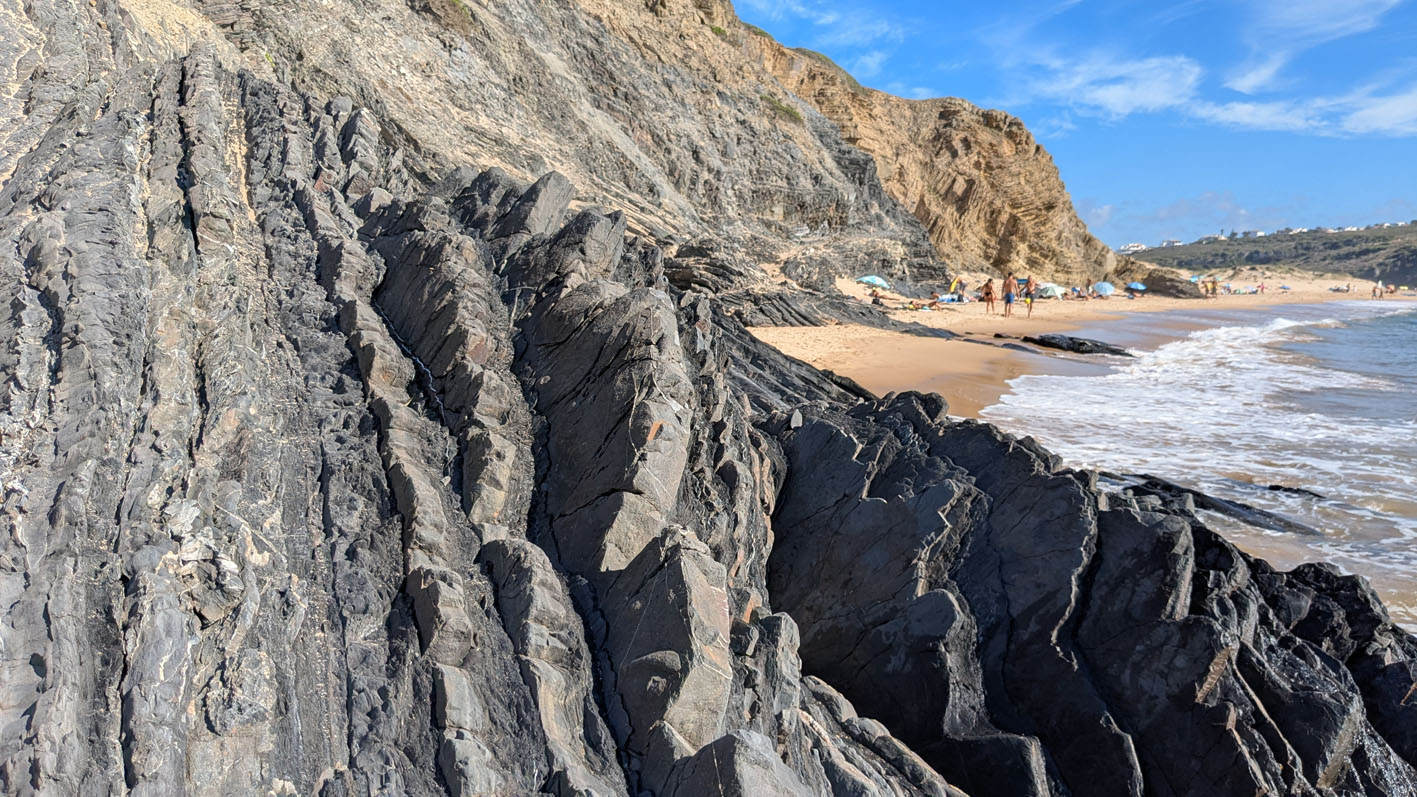
Turbidite sequences at the Amoreira beach, with the sturdier sand/siltstone sticking out and muddy layers more weathered. Photo by PS
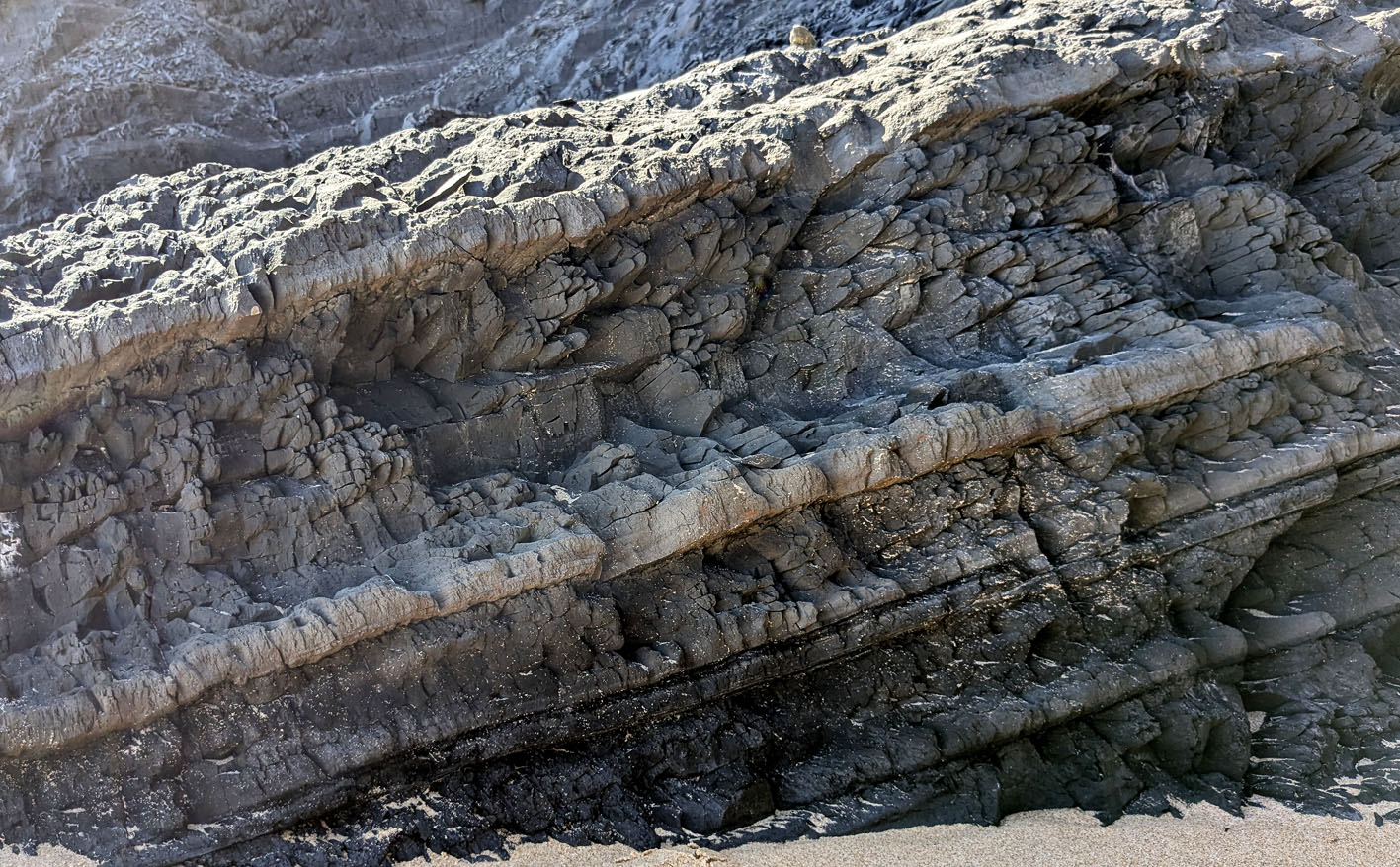
Intense weathering of heavily fissured turbidites, Amoreira beach. Photo by PS
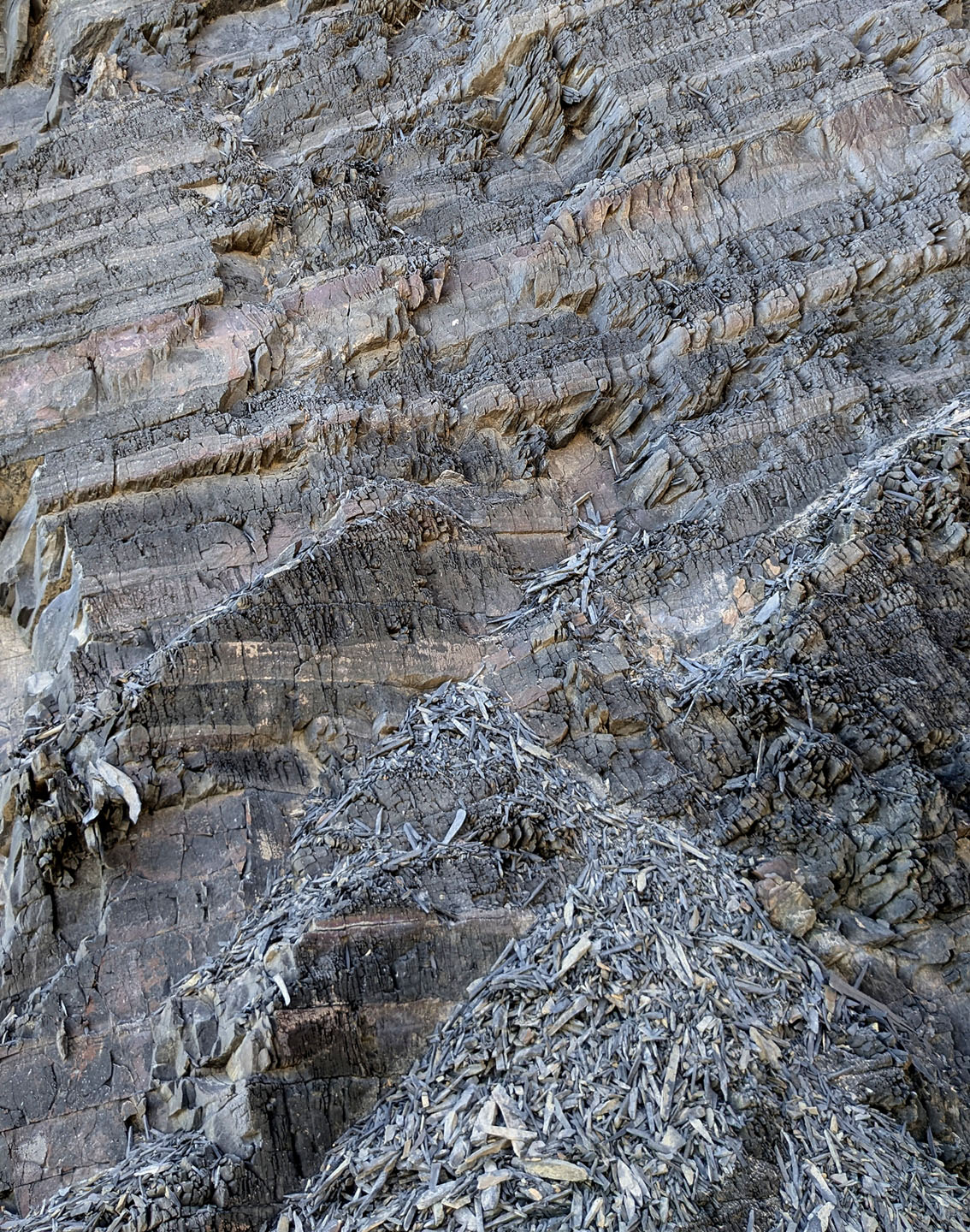
Elongated “sticks” a result of intense weathering of turbidites, Amoreira beach. Photo by PS

Small-scale tafoni in sand/siltstone layers in turbidites, Amoreira beach. Photo by PS
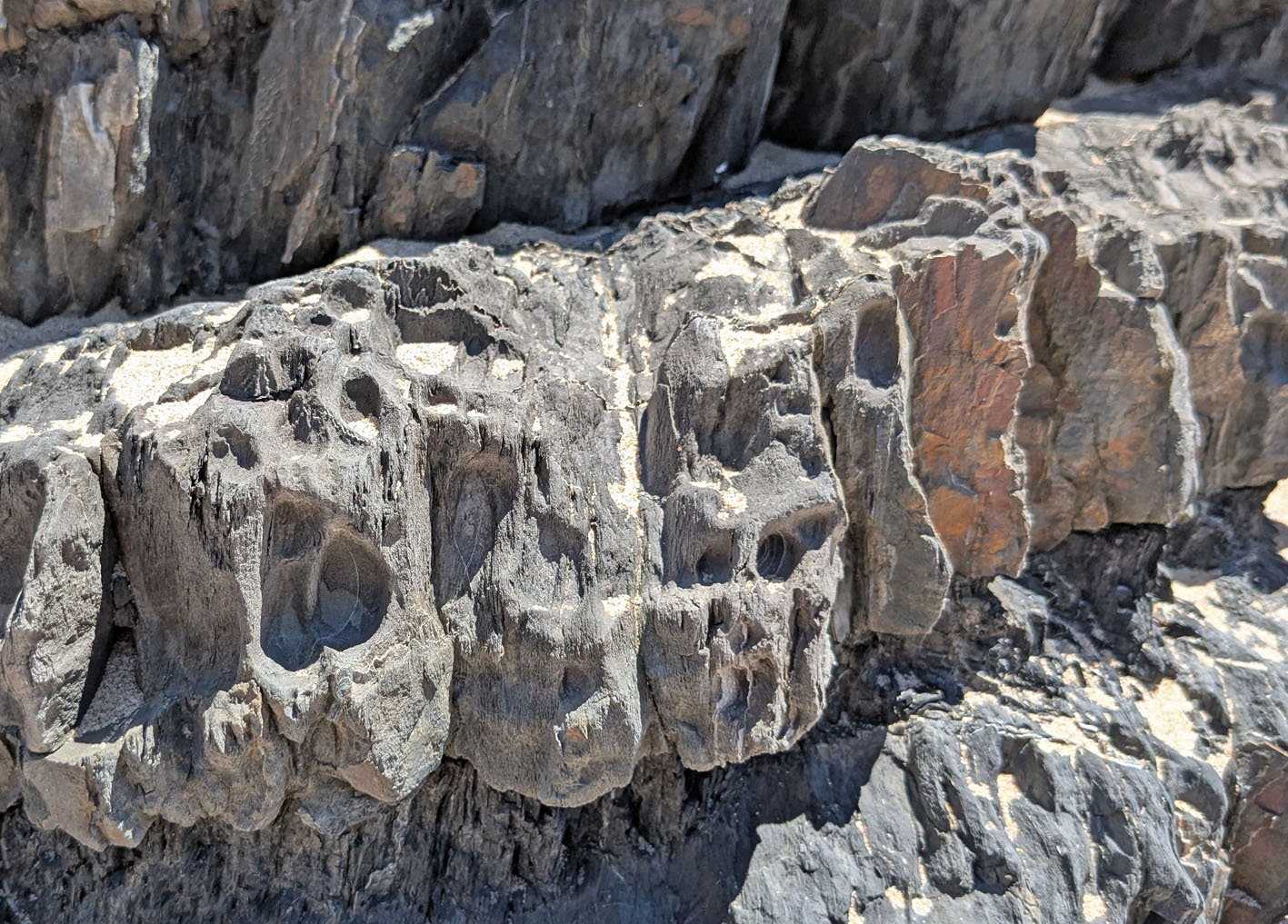
Small-scale tafoni in sand/siltstone layers in turbidites, Amoreira beach. Photo by PS

Another view of tafoni in turbidites at Amoreira beach. Similar forms are reported from turbidites in South Africa. Photo by PS
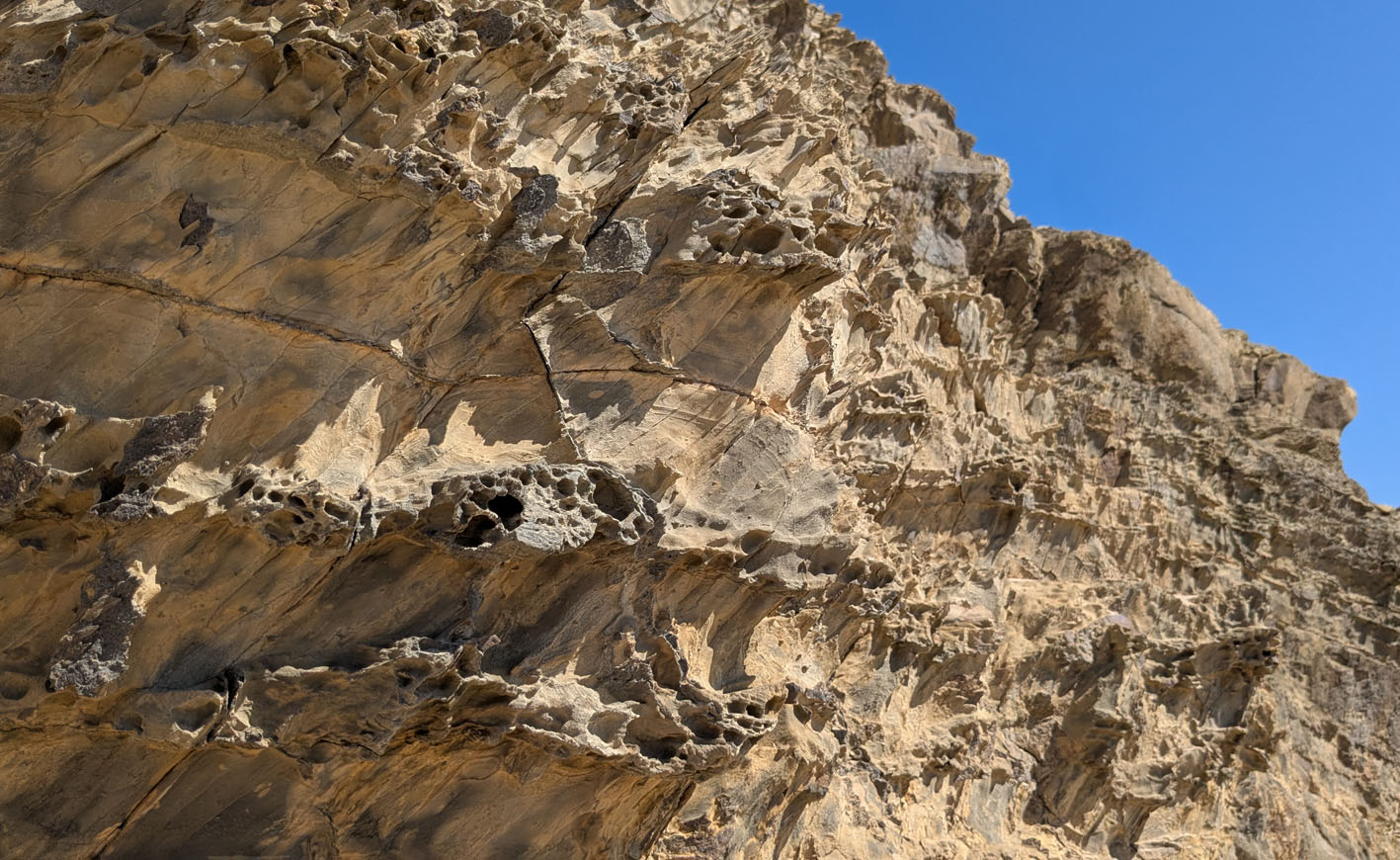
Tafoni in sturdier layers sticking out, while muddy layers retreat by more general salt weathering. Turbidites, Amoreira beach. Photo by PS
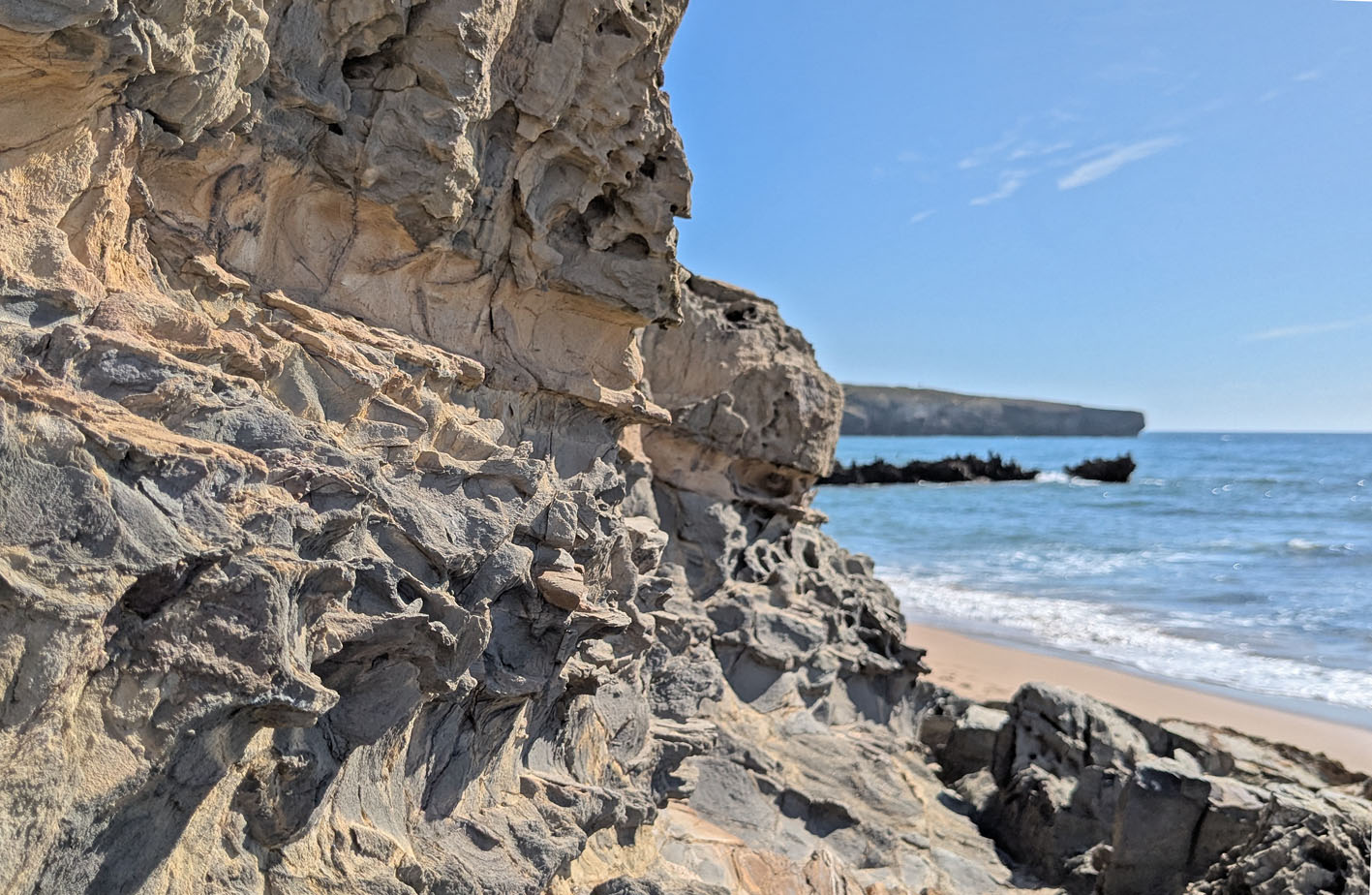
Tafoni in sturdier layers sticking out, while muddy layers retreat by more general salt weathering. Turbidites, Amoreira beach. Photo by PS
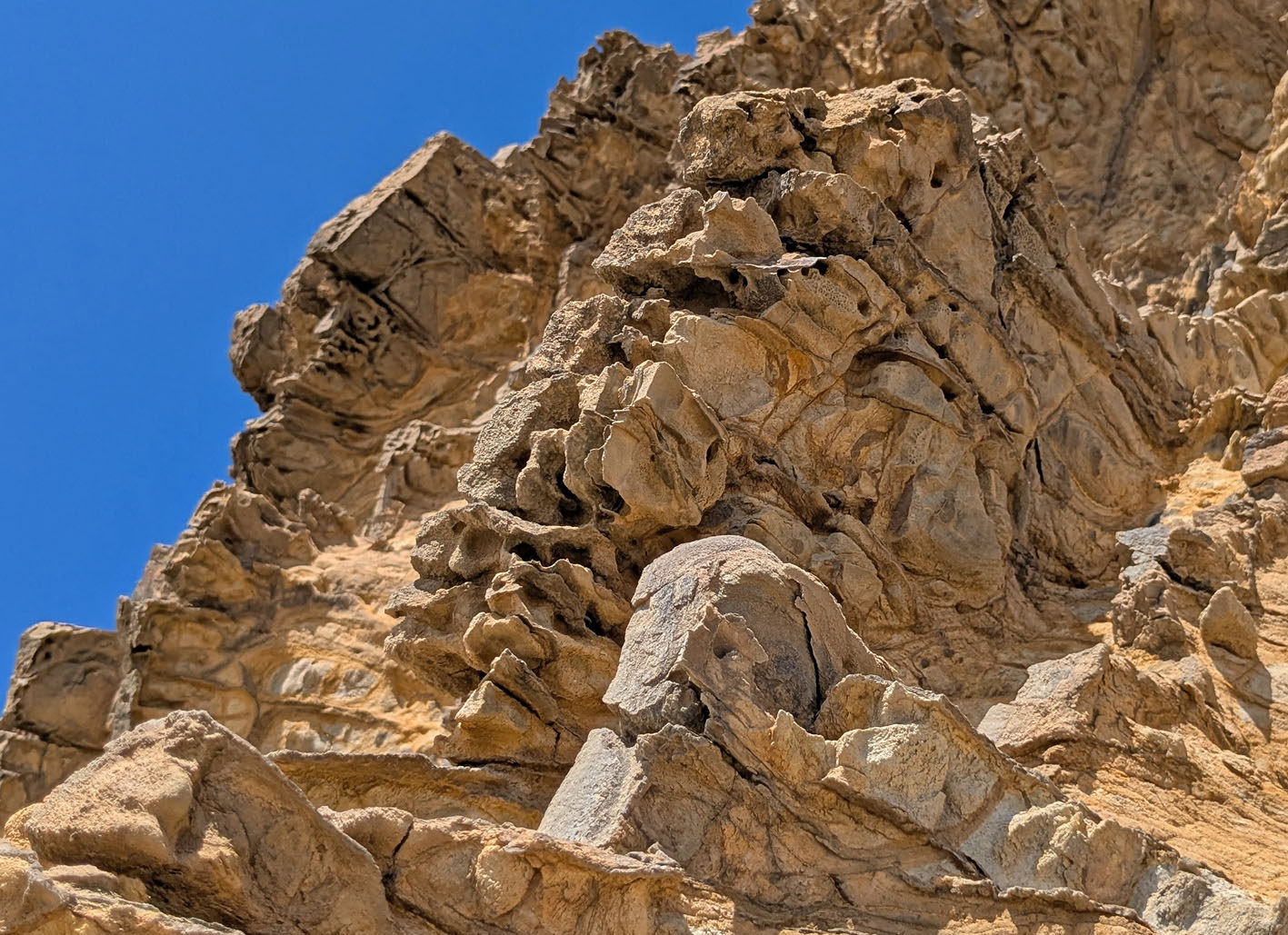
Intricate tafoni weathering in turbidites, Vale Figueiras beach. Photo by PS
Tafoni in calcareous sandstones
Tafoni in the turbidite sequences contribute to shaping parts of the coastal cliffs, but it is not a major reason for instability. Rockslides and collapse of cliffs are, however, major risks along Costa Vicentina, and it seems that tafoni developing in young and soft, calcareous sandstones capping the cliffs may sometimes contribute to instability.
The sandstones often represent aeolian dunes of Quaternary raised beaches. Spot tests (10% HCl) by and above the Telheiro and Amoreira beaches indicate that the friable rocks are very rich in carbonate, as grains and cement. As expected, the rocks contain significant amounts of chloride salts, as determined by test strips.
Tafoni comes in a variety of forms, from honeycomb and alveolar weathering via small-scale, irregular and connected holes to larger-scale caverns. In the upper reaches of cliffs, tafoni and general salt weathering sometimes give rise to undercutting, which eventually may contribute to collapse of overlying rock.
However, in many situations it is very difficult to distinguish tafoni from differential weathering due to rhizolith-formation, and often combinations seem to develop. Rhizoliths are, simplified, harder structures in the rock, formed due to chemical alteration by former growth of roots in the sand/rock. These structures normally do not weather as easily as adjacent rock fabric, whether by e.g. dissolution or tafoni/salt. Fine examples are given by Knight 2025.
The Triassic Silves sandstone is also prone to tafoni weathering, as can be studied at the Silves medieval castle. Though the castle is heavily restored, the older building stones often feature classic alveolar weathering.
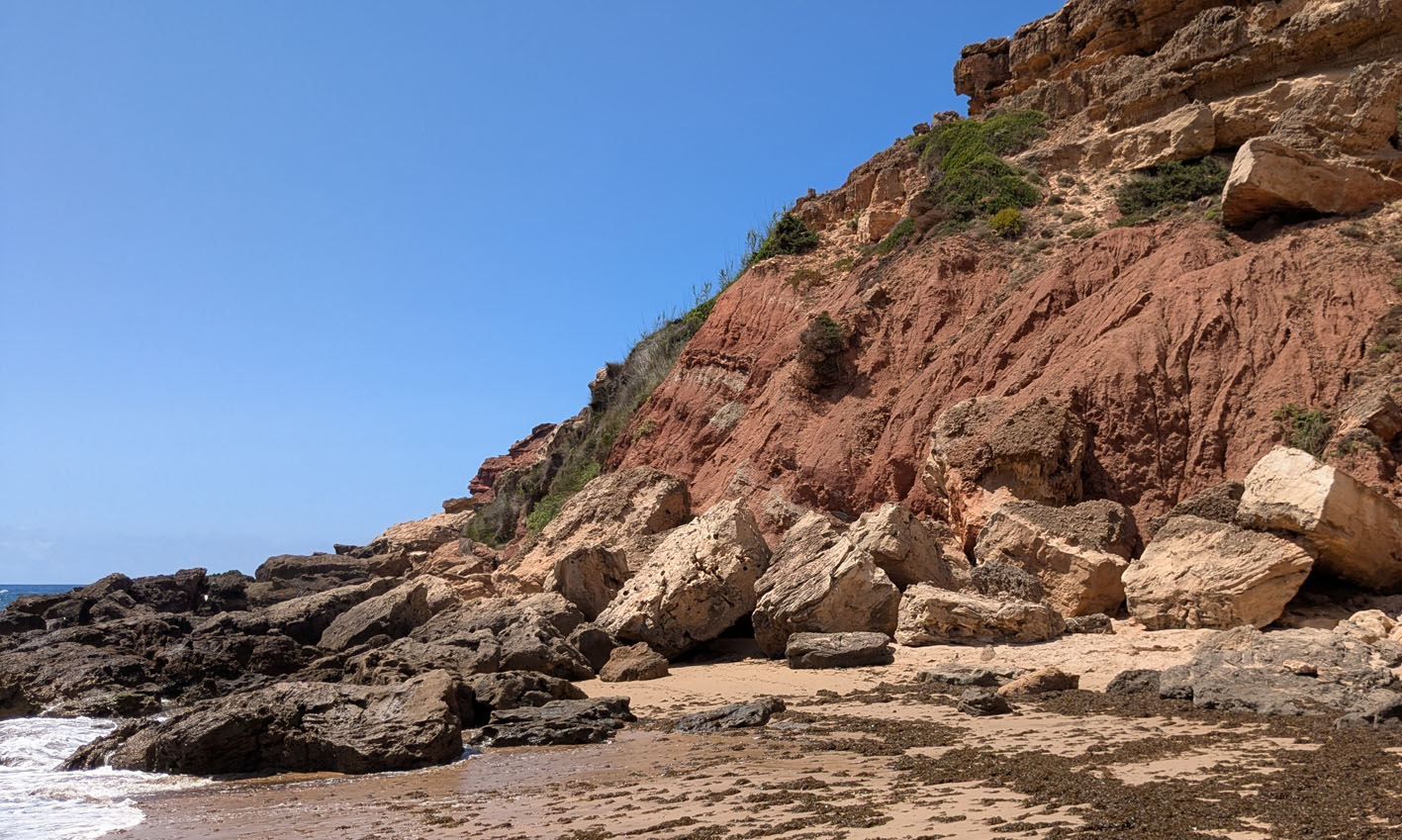
Rock fall at Telheiro beach. It is mainly the young calcareous sandstones at the top of the cliff that have fallen. Photo by PS
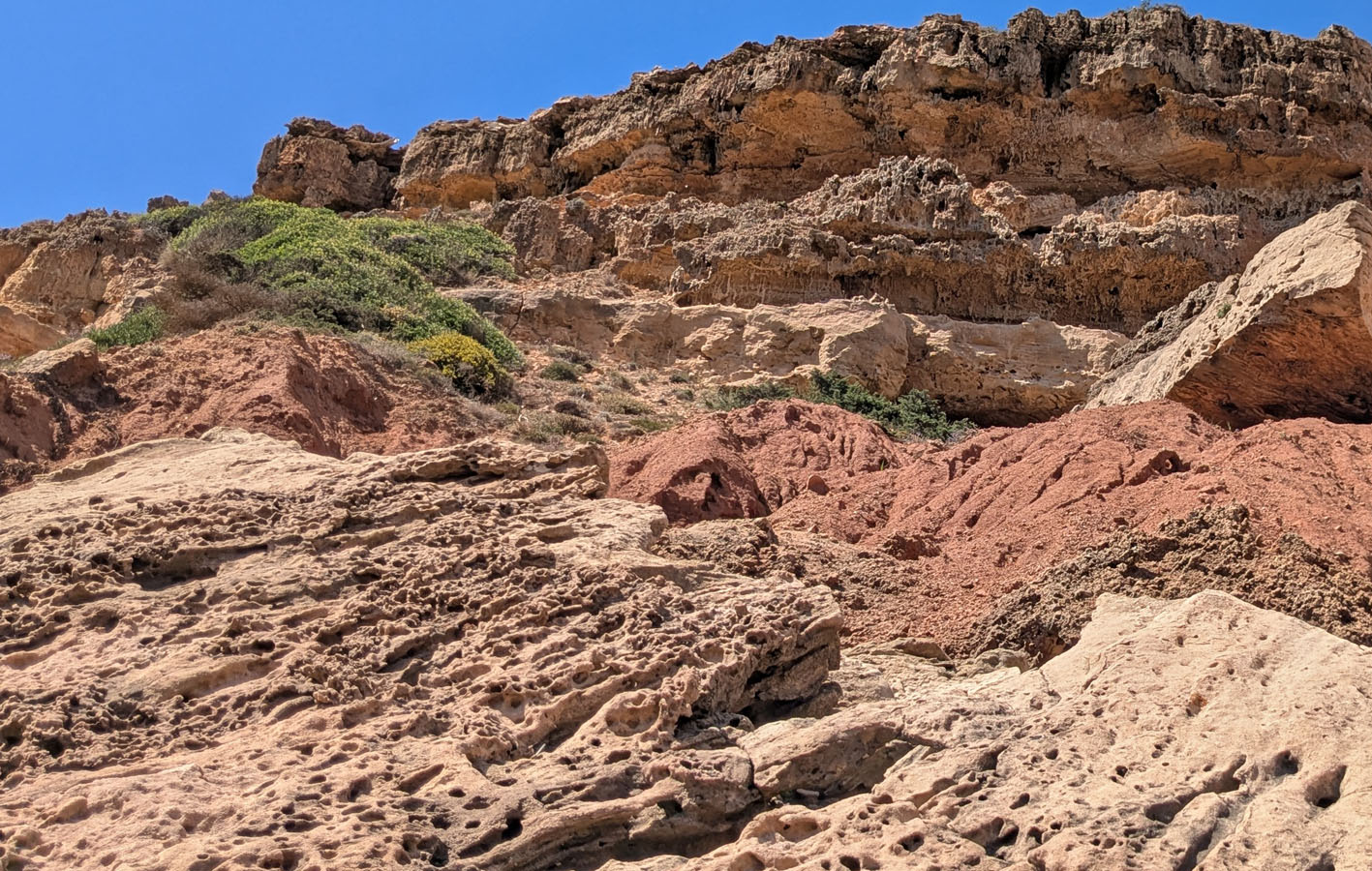
Differential weathering related to rhizoliths and tafoni has undermined the young, Quaternary calcareous sandstone at the top, contributing to rock fall at Telheiro beach. Tafoni on fallen blocks in the foreground. Cf. photo above. Photo by PS
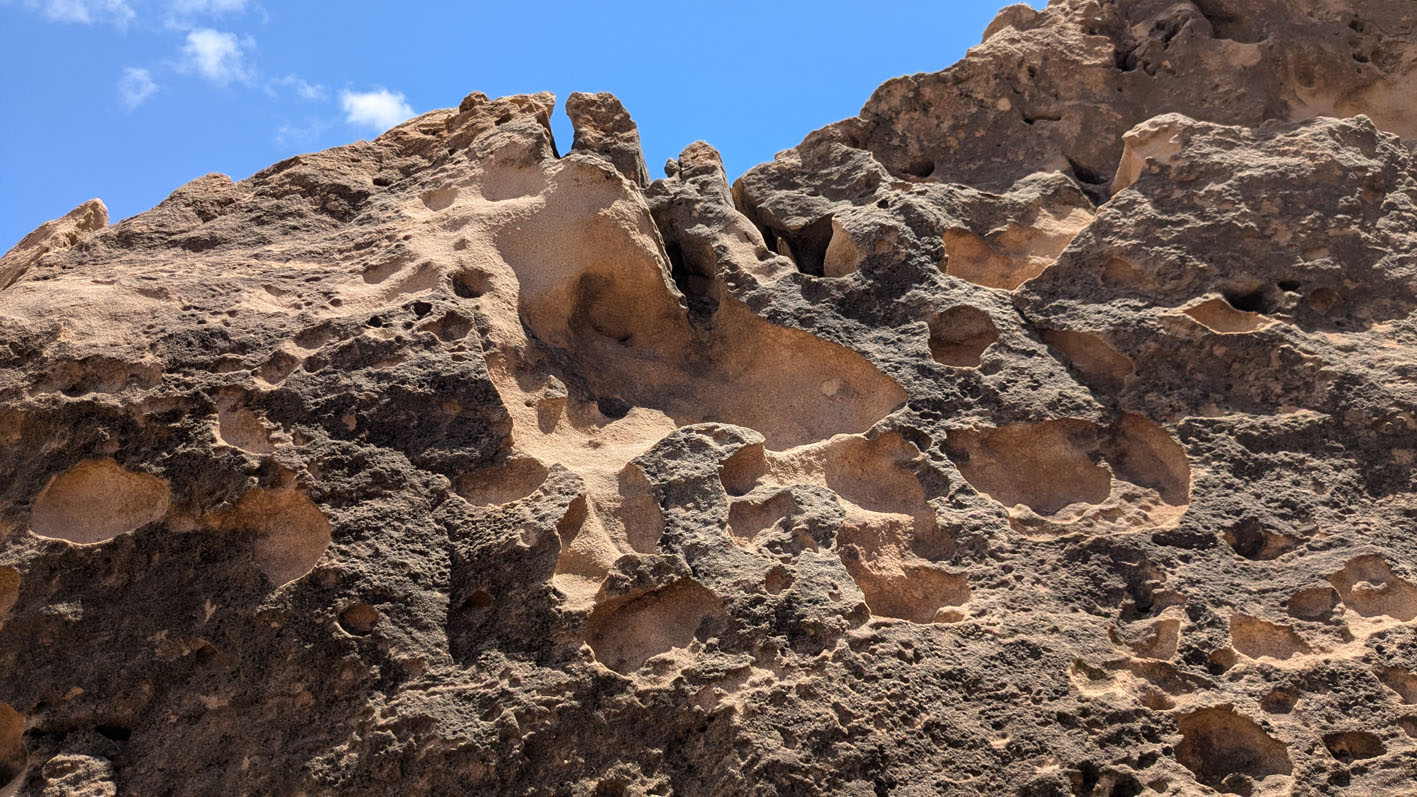
Classic, small-scale cavernous tafoni with case-hardened, darker surface. Quaternary calcareous sandstone, Telheiro beach. Photo by PS
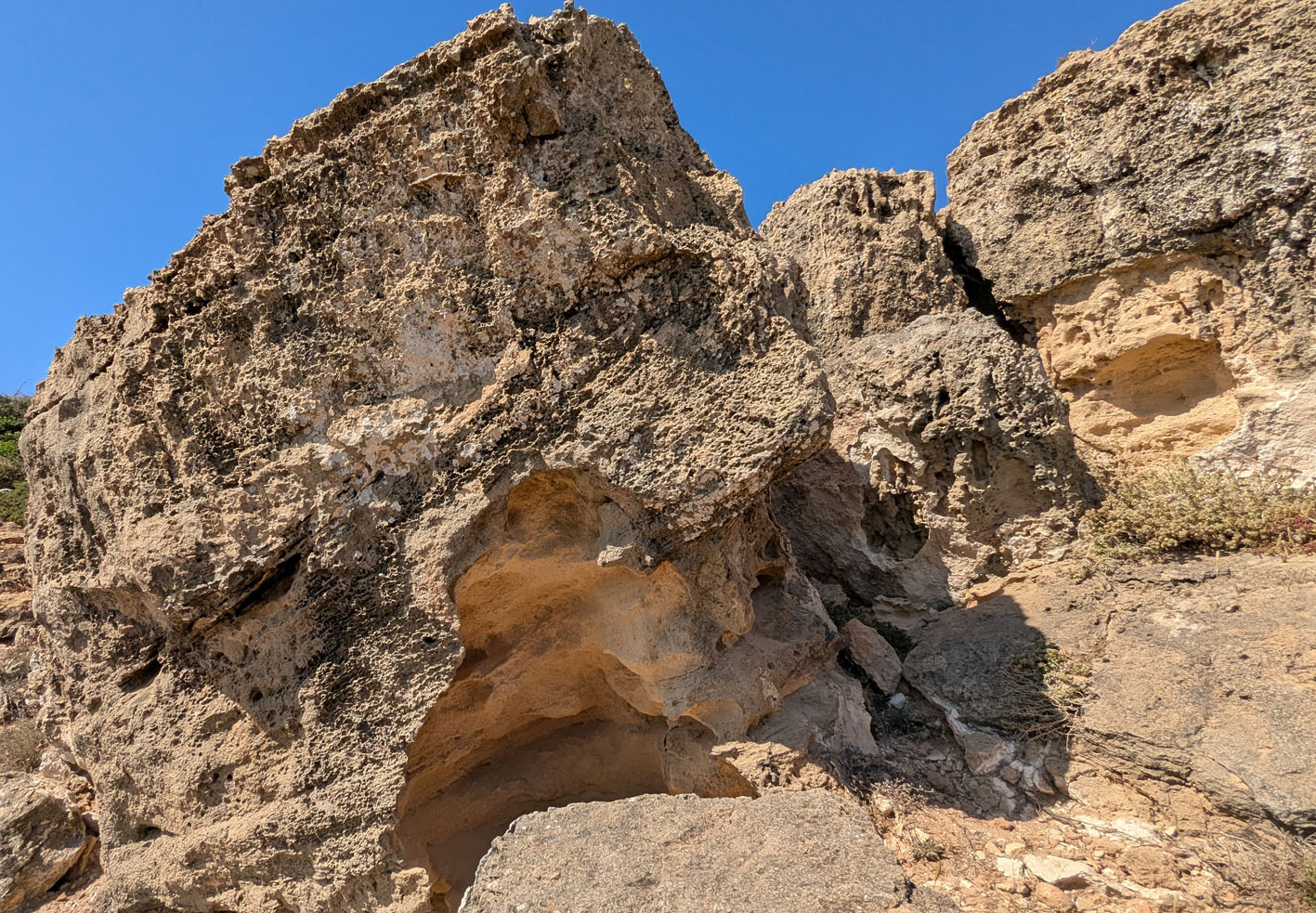
Larger-scale cavernous tafoni (ca. 1 m high). Quaternary carbonaceous sandstone, above Telheiro beach. Photo by PS
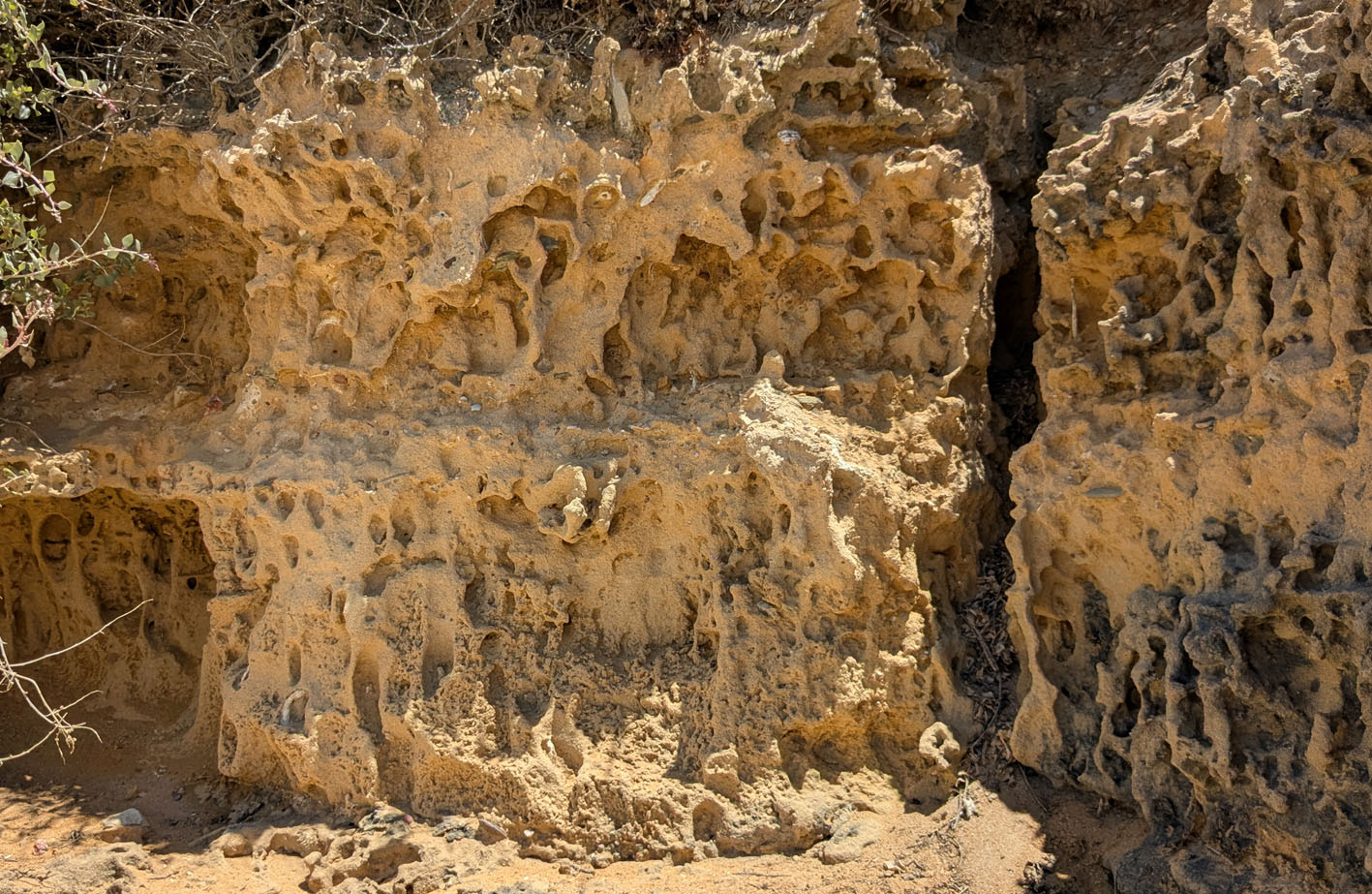
Honeycomb tafoni weathering in young calcareous sandstone. Beliche beach. Photo by PS
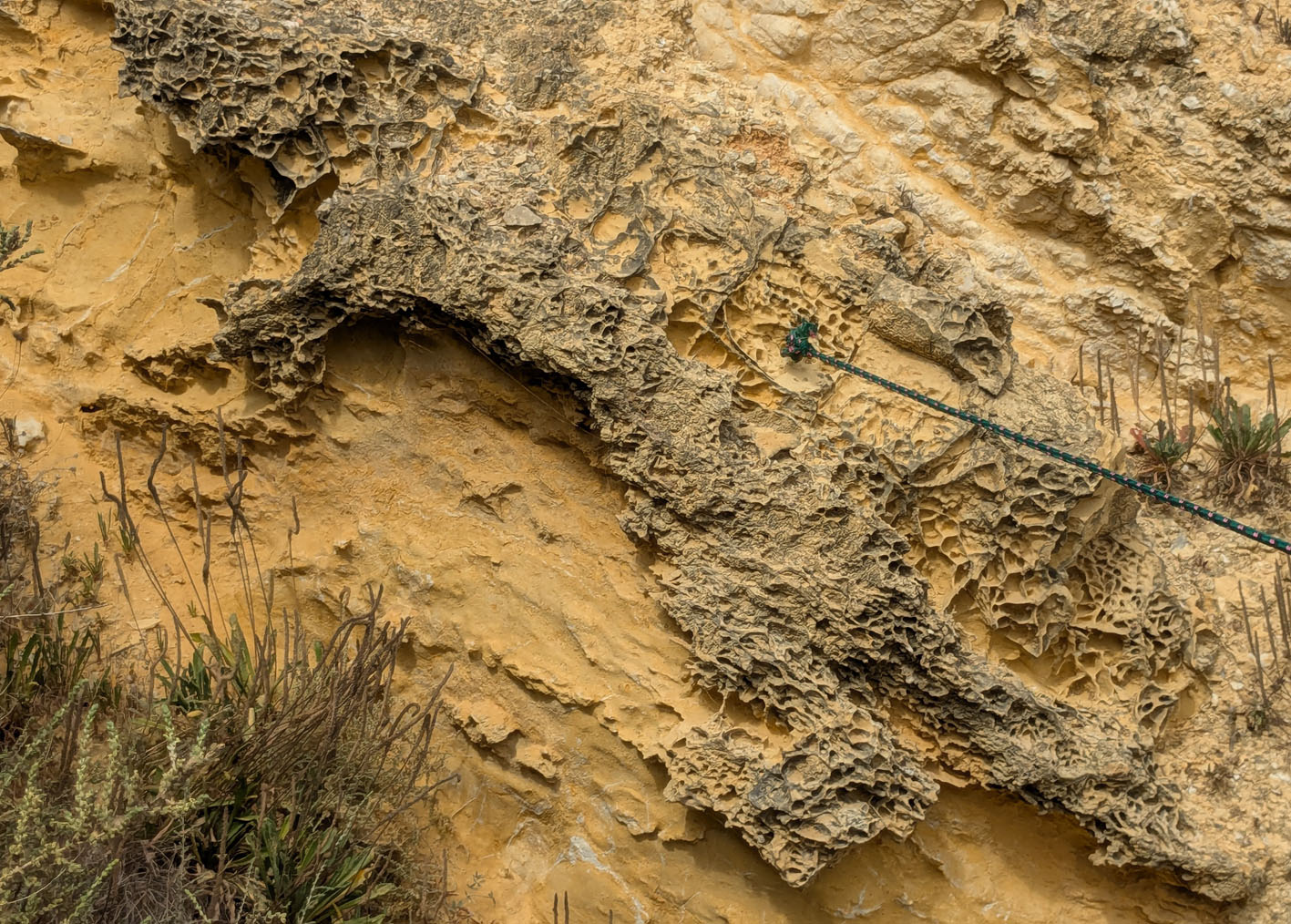
Differential weathering due to rhizoliths and possibly some tafoni. Amoreira beach. Photo by PS
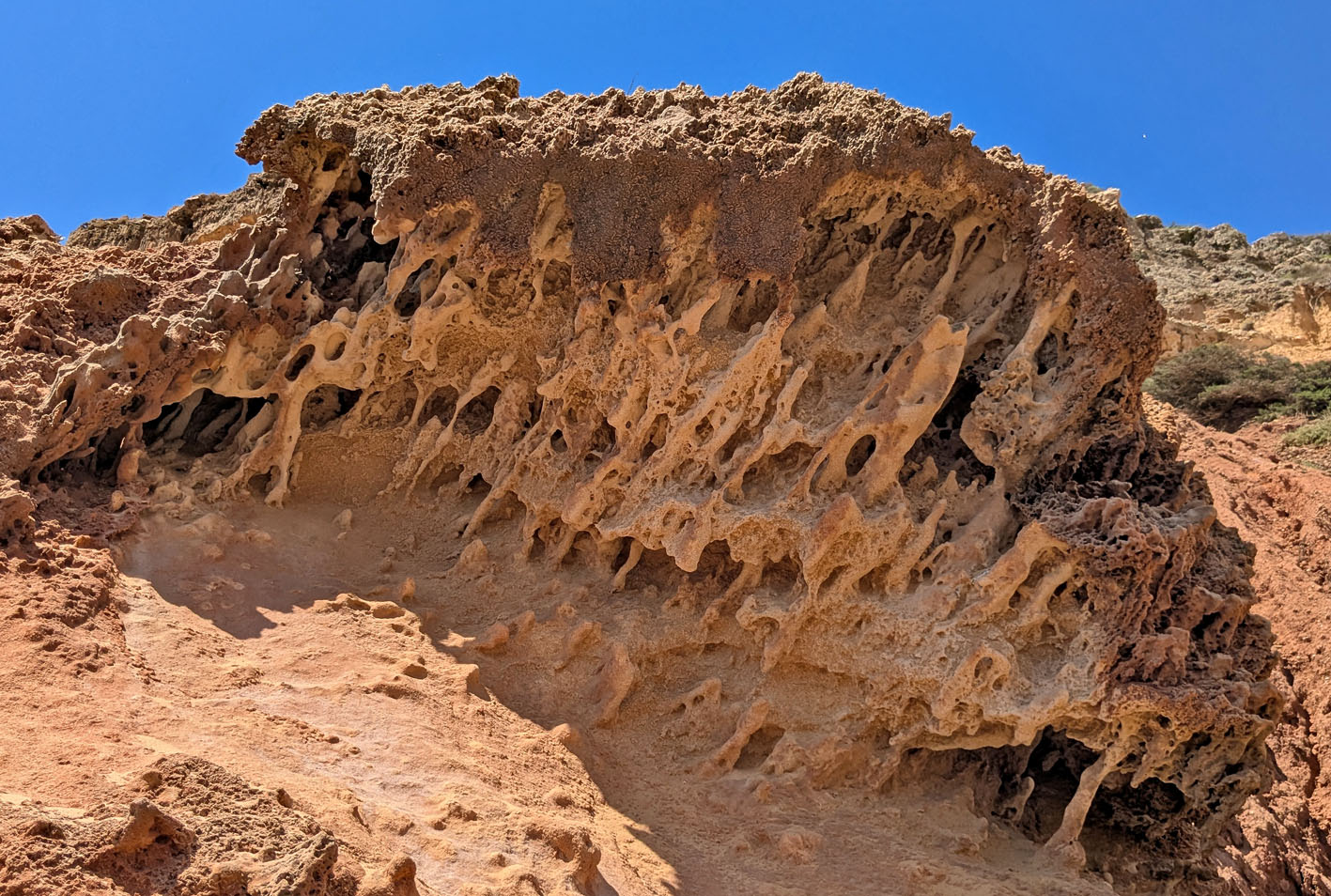
Differential weathering due to rhizoliths and possibly some tafoni. Telheiro beach. Photo by PS
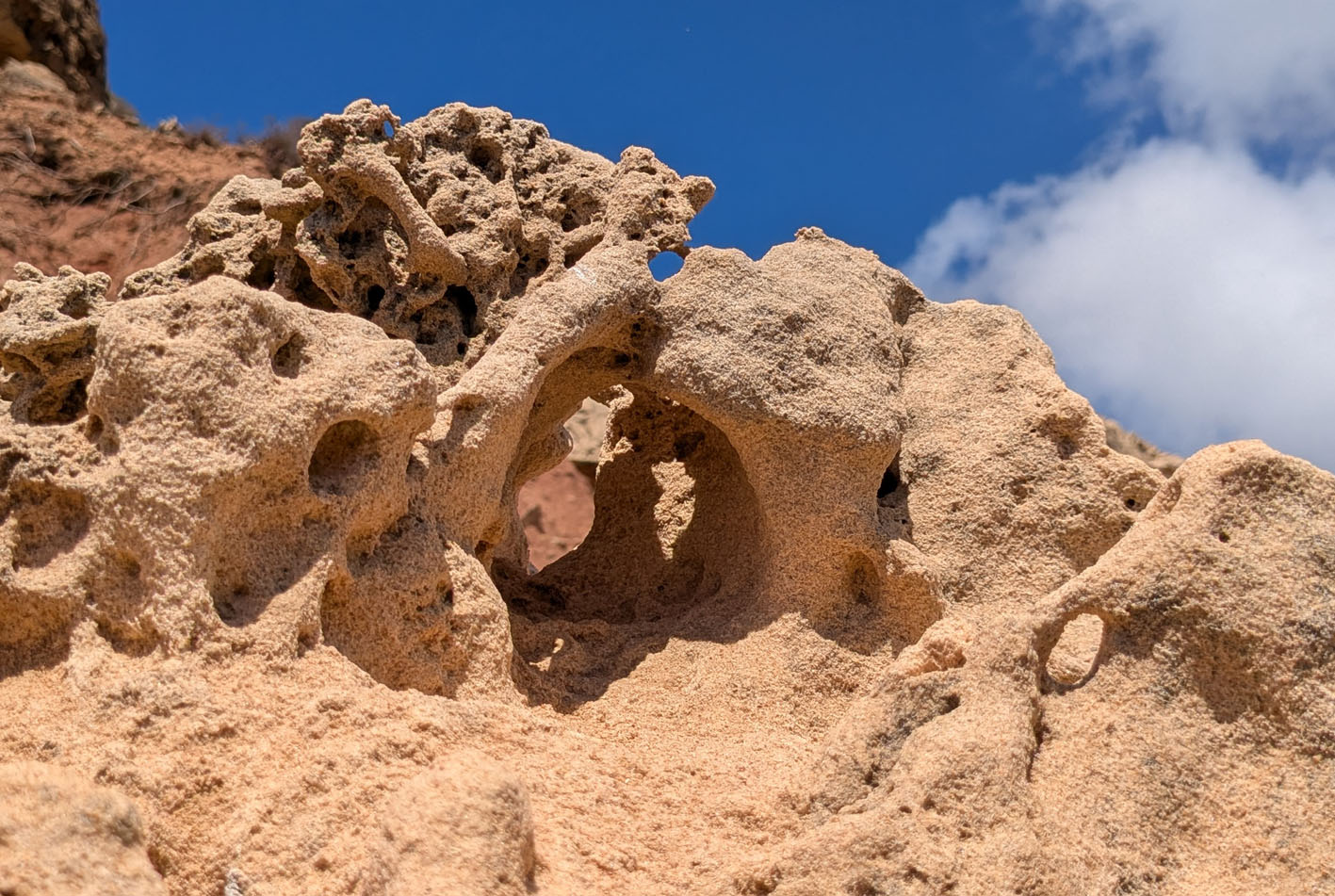
Rhizoliths sticking out of the differentially weathered calcareous sandstone. The holes may be due to tafoni weathering. Telheiro beach. Width of field in foreground c. 50 cm. Photo by PS
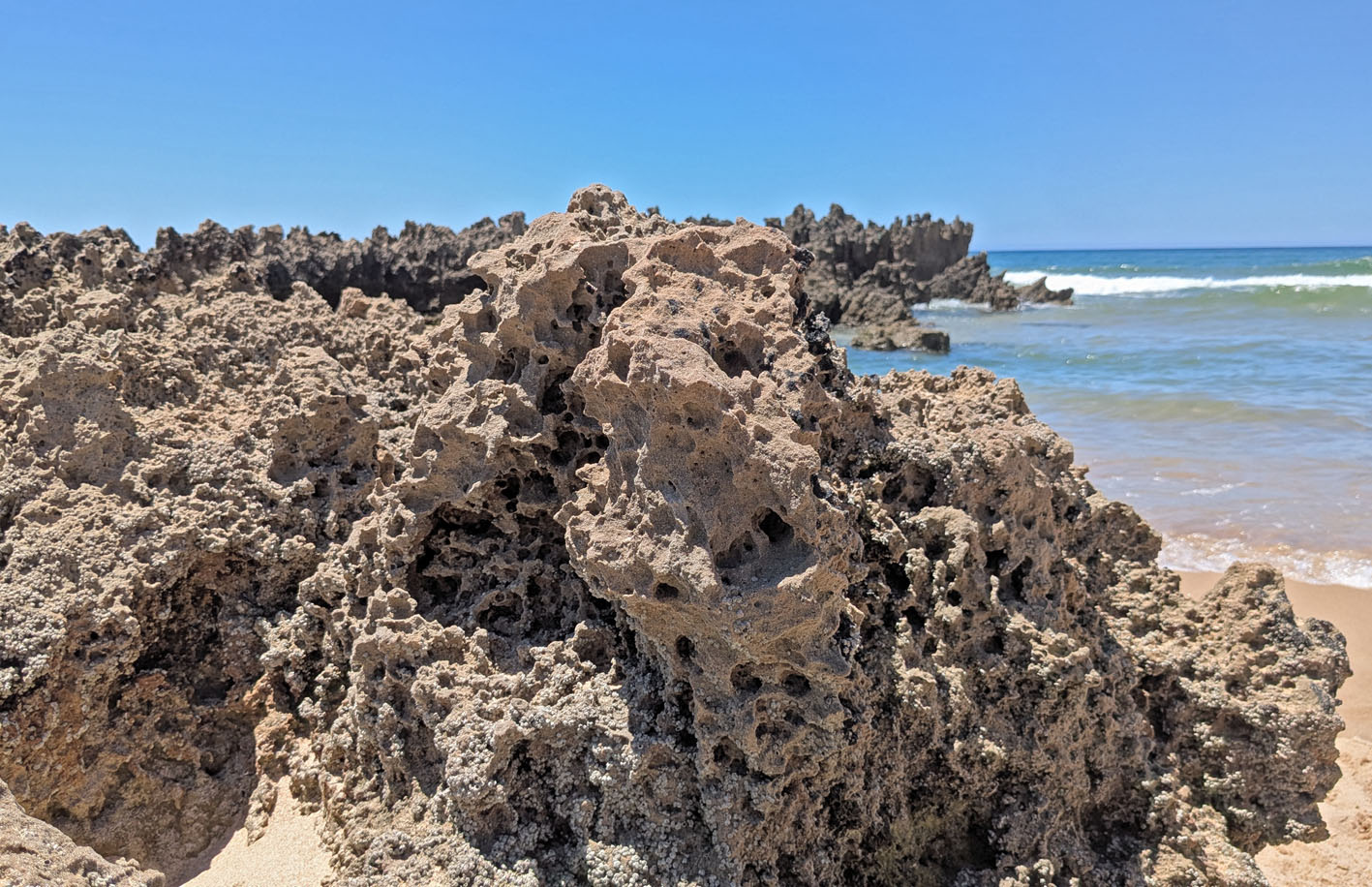
A calcareous sandstone promontory at Amoreira beach, presumably so full of holes because of differential weathering related to rhizoliths. But perhaps tafoni also plays a certain role. Photo by PS
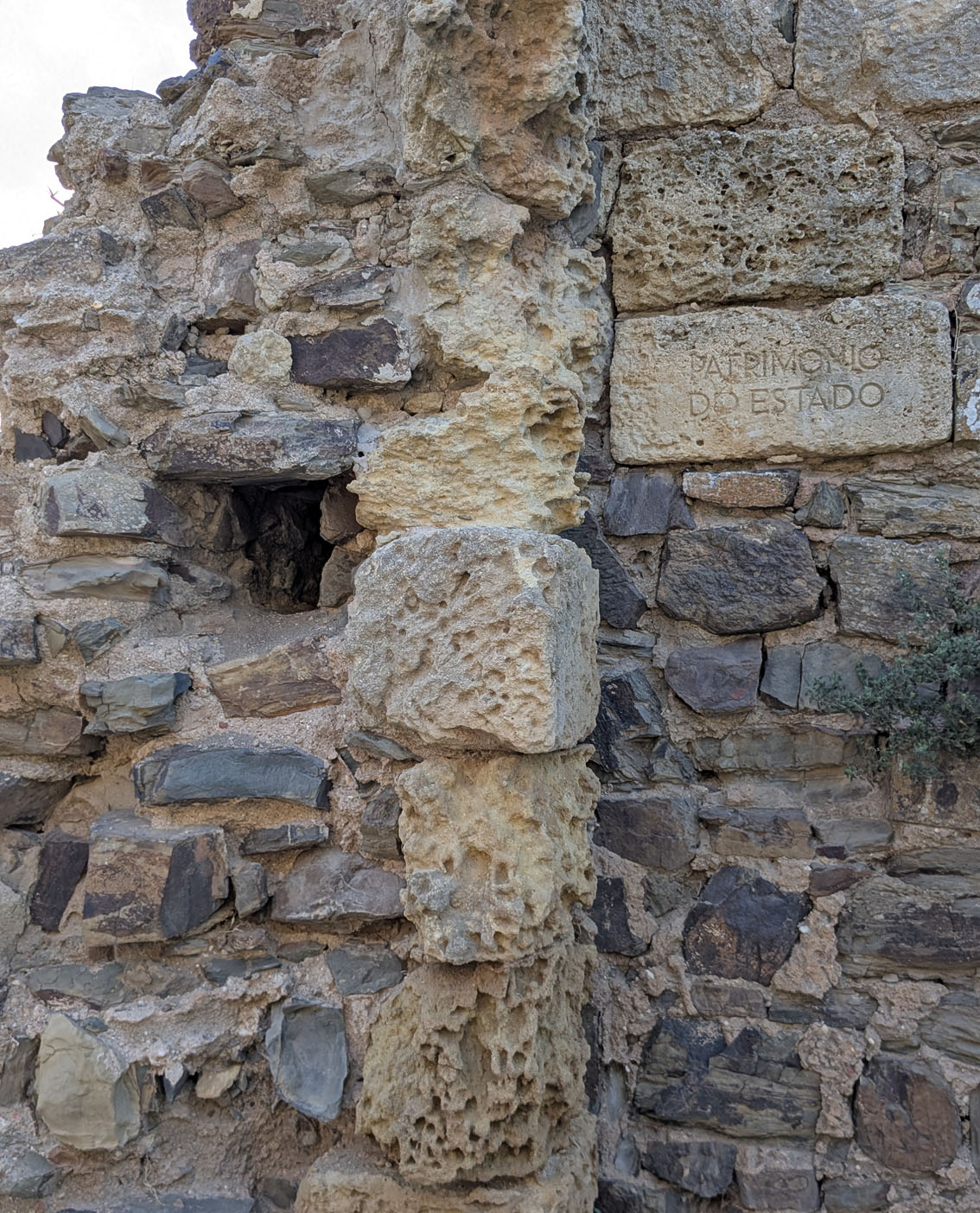
Young calcareuos sandstone has occasionally been used as building stone. Here at a ruined portal at the Aljezur medieval castle. Heavy weathering related to rhizoliths and tafoni. The dark rubble stone is sand/siltstone form the sturdier parts of Carboniferous turbidites. Photo by PS
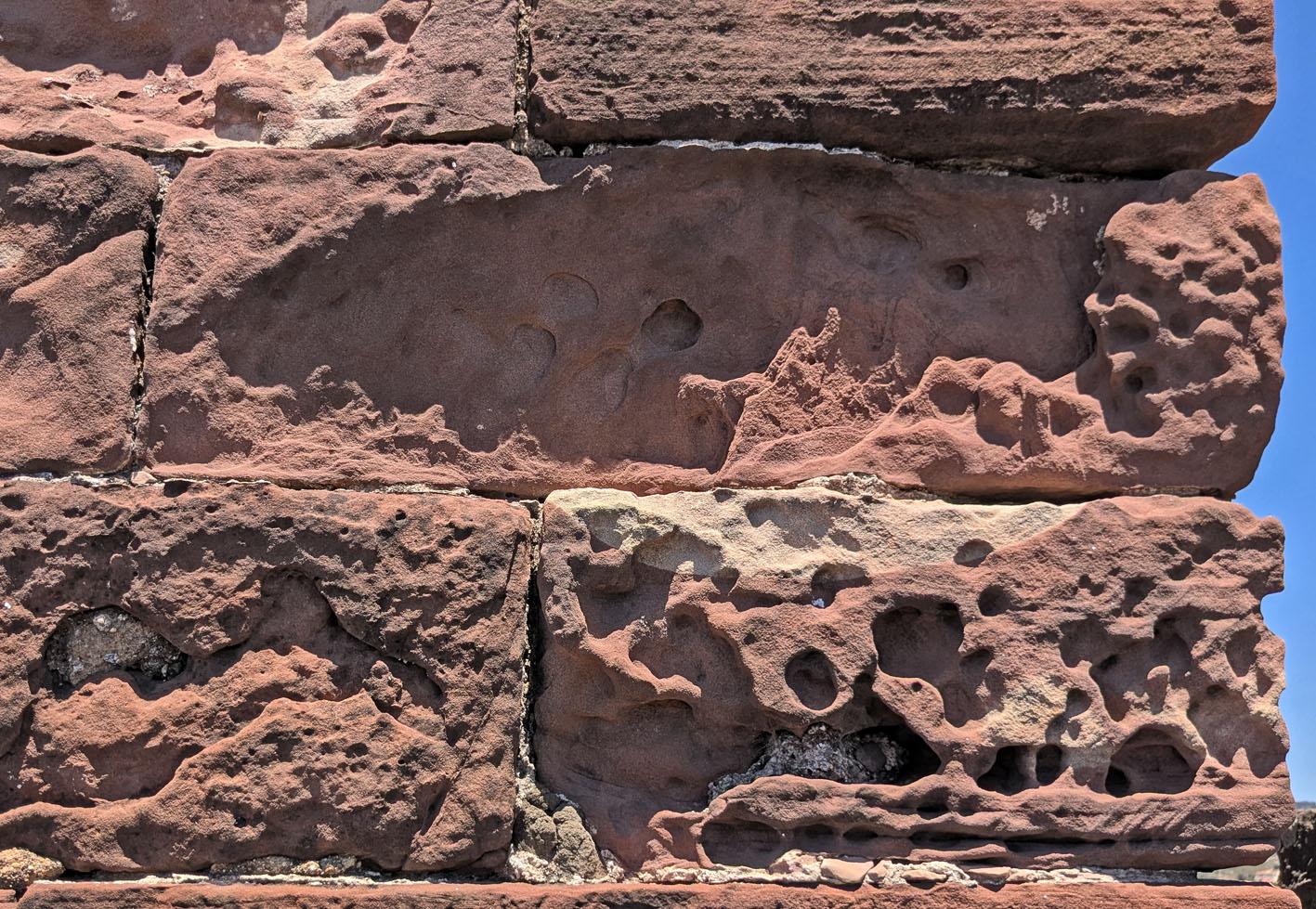
Small-scale tafoni weathering of Silves sandstone at the Silves medieval castle. Photo by PS
Diversity in tafoni weathering
We may often think of tafoni as regular honeycombs in sandstone and classic cavernous weathering in granite. But tafoni weathering is varied, indeed. The examples from Costa Vicentina highlight diversity because of rock properties and interplay with other weathering agents:
As opposed to homogeneous varieties of sandstone and granite, growth of tafoni may be heavily restricted in thin-bedded rock such as the folded and fissured turbidites at Costa Vicentina. Larger-scale and regular tafoni can hardly develop in these rocks due to the varying properties within the turbidite sequences, as well as cleavage, fissures and cracks.
And the seemingly homogeneous calcareous sandstone beach rocks turn out to be rather heterogeneous due to rhizolites. This implies that it is difficult to detect the tafoni component in the processes making all the bizarre forms and holes in the rock.
*
Read more about tafoni and geology from our roadtrips through Europe:
- Tafoni weathering on the island of Elba. Impressions and questions
- Tafoni in Tertiary shale at 2700 m in the Swiss Alps (Brigels, Graubünden)
- Impressions of limestone bioerosion on the Croatian island of Mljet
Discover more from Per Storemyr GeoKultur
Subscribe to get the latest posts sent to your email.





