The World Heritage Rock Art at Alta in Northern Norway

Reindeer hunter with bow and arrow (low, left) in the prehistoric Alta rock art. Photo: Per Storemyr

Reindeer hunter with bow and arrow (low, left) in the prehistoric Alta rock art. Photo: Per Storemyr

Earlier this week I attended a workshop on conservation of the prehistoric rock art at Alta in Northern Norway. This gave me the opportunity to take a closer look at the great Stone Age panels in the Hjemmeluft area, which is one of five major areas with rock art at the bottom of the extraordinarily scenic Alta Fjord (overview in Tansem & Johansen 2008). Discovered only some 50-60 years ago, the rock art at Alta became inscribed on the World Heritage List in 1985. It is the greatest concentration of rock art in the north of Europe, covering the period from the Stone Age to the Iron Age, or from c. 7000 to c. 2000 years ago. This is truly fascinating hunter-fisher-gatherer rock art, not least because many scenes may have their parallels in much younger, indigenous Sami practices and beliefs. Below is a collection of images and scenes – and landscapes – that particularly impressed me. Continue reading

Posted in Archaeology, Norway, Rock art | Tagged , , | Leave a comment

Making medieval stone architecture: the use of slate in Central Norway

The black phyllite schist quarry called "Sorte Skifer" at Stjørdal in Central Norway. It may have a tradition for procurement of slate back to the Middle Ages. Photo: Per Storemyr

The black phyllite schist quarry called “Sorte Skifer” at Stjørdal in Central Norway. It may have a tradition for procurement of slate back to the Middle Ages. Photo: Per Storemyr

The use of slate has traditions back to the Neolithic in Norway. Stone that were easy to split could be used for anything from the erection of fine burial chambers to the production of knives – phenomena that have been well documented by numerous archaeological excavations. It is much more difficult to say anything sensible about the medieval use of slate in the country. There is, for instance, only one historic reference to slate as roofing material at medieval buildings. This document, written by Bishop Arne in 1308, concerns King Haakon’s Hall in Bergen, built from the middle of the 13th century onward. The building was apparently roofed with fine slate from the famous quarries at Jondal in Hardanger, which are still in operation. However, recent observations in the Trondheim region indicate that slate for roofing – and masonry construction – may have been more widespread, and that the use of slate as a building material for medieval architecture goes back to around 1100. Continue reading

Posted in Archaeology, Norway, Old quarries | Tagged , , , , , , , | 4 Comments

A masterpiece of Epipalaeolithic geometric rock art from el-Hosh, Upper Egypt

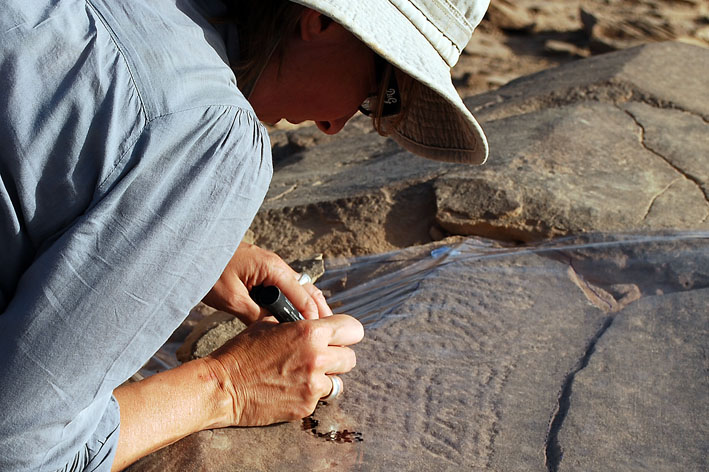
Isabelle Therasse of the Royal Museums of Art and History in Brussels drawing the Epiplalaeolithic masterpiece rock art. Photo: Per Storemyr

Isabelle Therasse of the Royal Museums of Art and History in Brussels tracing the Epiplalaeolithic rock art masterpiece in 2010. Photo: Per Storemyr

The rock art at el-Hosh in Upper Egypt is renowned for its fish trap motifs dating to the Epipalaeolithic period (c. 9000-5000 BC). However, during the 2010 field season undertaken by the Royal Museums of Art and History in Brussels several additional rock art motifs were discovered near the fish traps. One of these motifs is a true masterpiece of Egyptian rock art, which has now been published by Dirk Huyge and myself in the Sahara journal. It is a complex geometric drawing, and though parallels are almost completely lacking, the general style fits with previously discovered ladder motifs at el-Hosh – all dating to the Epipalaeolithic. Continue reading

Posted in Ancient Egypt, Archaeology, Rock art | Tagged , , | 1 Comment

Alpine heritage impressions from a summer in Grisons (Graubünden, Switzerland)

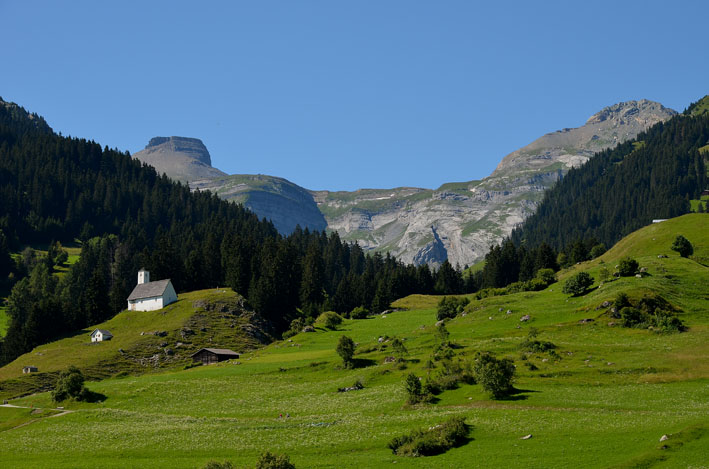
A view to the little medieval church called Sogn Sievi (St. Eusebius), situated by a former castle on top of a small hill at Brigels. Photo: Per Storemyr

A view to the little medieval church called Sogn Sievi (St. Eusebius), situated by a former castle on top of a small hill at Brigels. Photo: Per Storemyr

Grisons – or in German Graubünden – is the largest canton in Switzerland, in the middle of the Alps, bordering Italy and Austria. It is renowned for its magnificent nature and countless medieval castle ruins. But Grisons has a truly varied heritage. Join me on a trip I took with my family this summer and enjoy aspects of its less well-known, but still spectacular nature and cultural heritage! Continue reading

Posted in Archaeology, Old mines, Old quarries, Rock art, Ruins, Switzerland | Tagged , , , , | 4 Comments

Good stone doesn’t change its location!

TThe 12th century greenschist (chlorite schist) quarry at Øysanden, 17 km south of Trondheim. It was used for building Nidaros cathedral, but did it have a history beyond the Middle Ages? Photo: Per Storemyr

The 12th century greenschist (chlorite schist) quarry at Øysanden, 17 km south of Trondheim. It was used for building Nidaros Cathedral, but did it have a history beyond the Middle Ages? Photo: Per Storemyr

There have been few new posts on my blog recently. But there is a very good reason for this apparent laziness, since I’m now writing a book about stone. Or, to be more correct, a book about the cultural history of stone and quarries that led to the building of Europe’s northernmost medieval cathedral, Nidaros Cathedral in Trondheim, Norway. Continue reading

Posted in Archaeology, New projects, Norway, Old quarries | Tagged , , , , , , , | Leave a comment

Quarrying of soft stone through history

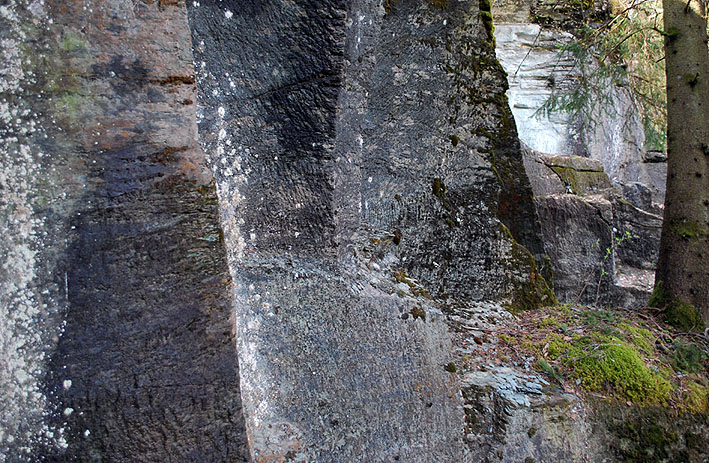
Krauchthal: Extraction marks from the pickaxes in the difficult corners

Krauchthal, Berne, Switzerland, around 1900: Extraction marks from pickaxes in difficult corners

Quarrying of soft stone has been done with remarkably uniform methods over the last 5000 years. From Ancient Egypt to modern Norway – soft stone, like sandstone, limestone and soapstone, was nearly always taken from bedrock using chisels or picks. I have collected a few previous posts about this phenomenon, and hope they may be of interest:

Posted in Archaeology, Old quarries | Tagged , , | Leave a comment

The Palaeolithic rock art in Wadi Abu Subeira, Egypt: Landscape, archaeology, threats and conservation

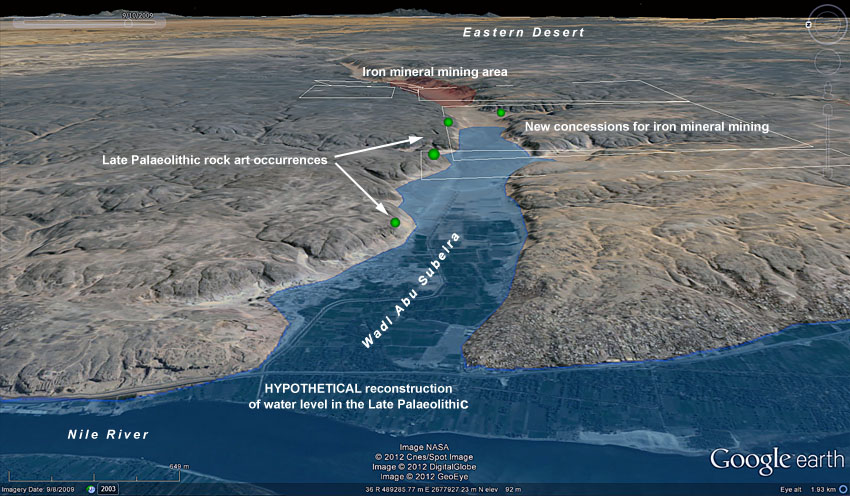
This is how Wadi Abu Subeira may have looked like at the time of the making of the Late Palaeolithic rock art, some 15-20.000 years ago. Hypothetical reconstruction by Per Storemyr based on information on rock art locations from Adel Kelany and on the general knowledge of the geomorphology in the area, provided in Wendorf & Schild (1989). Only field studies can confirm the hypothesis.

Rock art by a “fjord” along the Nile? This is how Wadi Abu Subeira may have looked like at the time of the making of the Late Palaeolithic rock art, some 15-20.000 years ago. The iron mining concessions that may destroy the rock art are also indicated. Hypothetical reconstruction by Per Storemyr based on information on rock art locations from Adel Kelany and on the general knowledge of the geomorphology in the area, provided in Wendorf & Schild (1989). Only field studies can confirm the hypothesis.

Since the publication of the threats to the Palaeolithic rock art in Wadi Abu Subeira three weeks ago, there has been much response through e-mail and social media, and the case has been covered by many online magazines and blogs. People in Egypt and elsewhere are concerned, and I wish to thank you all for your interest and for bringing the case along to friends and colleagues, as well as to administrators and politicians. There now seems to be a need for an “unbiased”, comprehensive overview of what is actually known about the landscape, the archaeology, the rock art, the threats, current conservation efforts and options for the future. The overview below is based on published literature, and information that otherwise belongs to the public sphere. It is written in close cooperation with Adel Kelany, and we have benefitted from input by Dirk Huyge. Continue reading

Posted in Ancient Egypt, Archaeology, Heritage destruction, Rock art | Tagged , , , , , , | 5 Comments

Wadi Abu Subeira, Egypt: Palaeolithic rock art on the verge of destruction

Adel Kamel of the Supreme Council of Antiquities in Aswan recording Late Palaeolithic rock art while heavy trucks are transporting clay for the Egyptian ceramics industry in the background. Photo: Per Storemyr

Emergency in Wadi Abu Subeira: Adel Kamel of the Supreme Council of Antiquities in Aswan recording Late Palaeolithic rock art. In the background: Heavy trucks transporting clay from the numerous mines in the wadi. The clay is used in the Egyptian ceramics industry. Photo: Per Storemyr

In 2006 one of the most important recent archaeological discoveries in Egypt were made in Wadi (Chor) Abu Subeira near Aswan: A team led by Adel Kelany of the Supreme Council of Antiquities (SCA) found a stunning assemblage of petroglyphs dating to the Late Palaeolithic era (c. 15-20.000 years ago). Ongoing surveys have shown that the initial find was the tip of the iceberg only, which makes Subeira perhaps the richest place of “Ice-Age” art in North Africa, comparable to the site of Qurta, 50 km to the north. Unfortunately, the Subeira rock art is extremely threatened by modern mining, which lately has proven to be even more widespread than previously thought: A truly unique testimony of mankind’s early art is now on the verge of destruction. Continue reading

Posted in Ancient Egypt, Archaeology, Heritage destruction, Rock art | Tagged , , , , | 8 Comments

For those who didn’t really get the Levallois technique


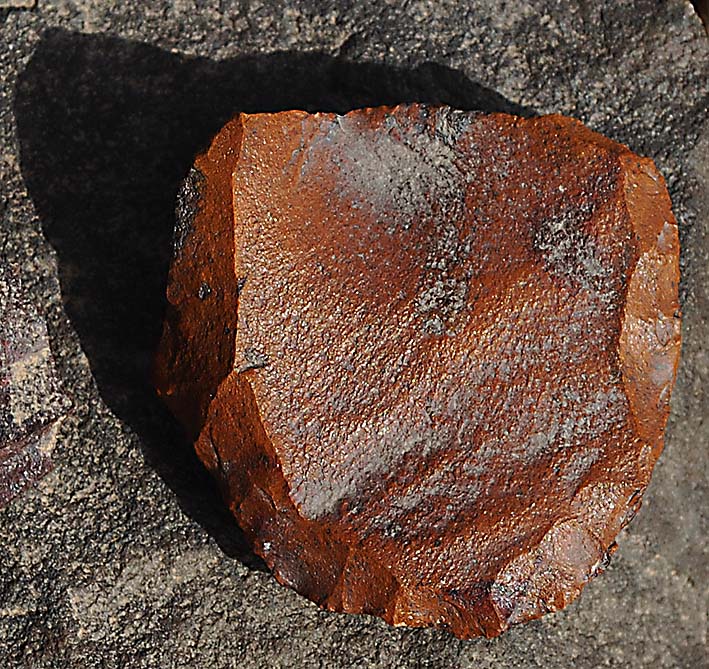
I didn’t make this fine animation, it is the work of José-Manuel Benito Álvarez, check at Wikimedia Commons and at Wikipedia. But I did take the photo, before, I have to admit, I really got it. You see, I’m fond of stone, and the reddish-orange silicified sandstone (quartzite) at Wadi Abu Subeira, near Aswan in Egypt, makes my heart jump… I guess the Levallois core was prepared in the Middle Palaeolithic, quite some thousands of years ago.

Happy Easter!

Posted in Ancient Egypt, Archaeology | Tagged , , | Leave a comment

Mickey Mouse in rock art at Gharb Aswan (Egypt): Was he fond of sound?

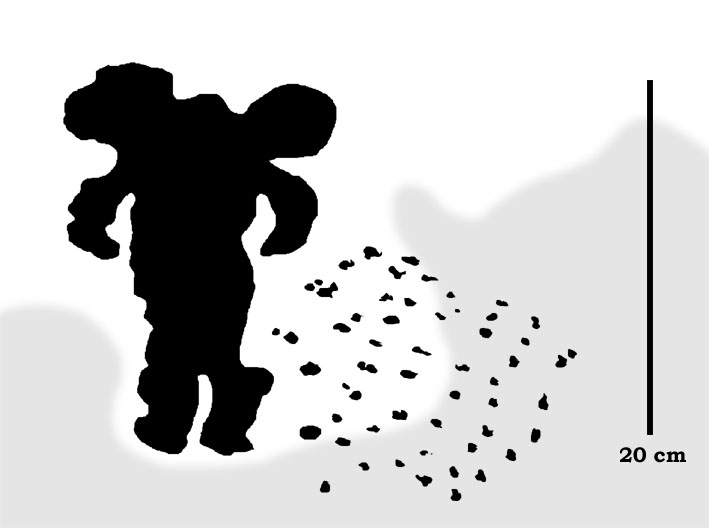
Mickey Mouse at Gharb Aswan. Tracing by Per Storemyr (after own photo)

Mickey Mouse at Gharb Aswan. Tracing by Per Storemyr (after own photo)

Though Prehistoric rock art certainly had a meaning, its implications usually remain mysterious for us moderns. But sometimes the rock art conveys funny things to speculate on. What about big-eared Mickey Mouse at Gharb Aswan in Upper Egypt: Was he particularly fond of music?

Mickey may have been carved in the Neolithic or Epipalaeolithic period, some 6.000-10.000 years ago. Continue reading

Posted in Ancient Egypt, Archaeology, Rock art | Tagged , , | Leave a comment